




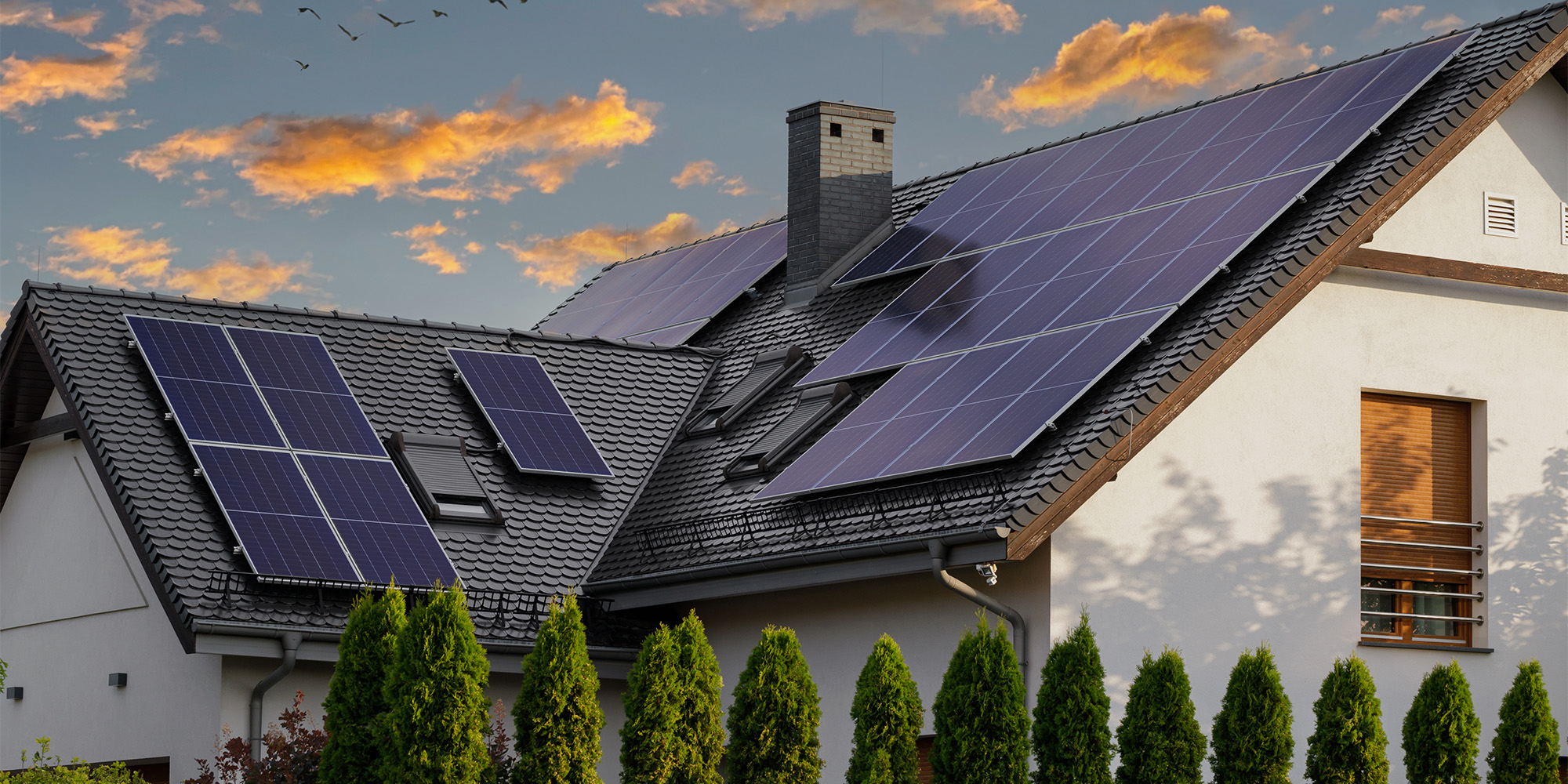
Automating a Sustainable Home with Homey and Solar Energy
Modern sustainable homes often feel like a fragmented collection of apps for solar panels, heat pumps, and EV chargers. Homey transforms these individual components into a unified Home Energy Management System (HEMS) that automates your energy usage and improves efficiency.
From a collection of devices to one sustainable system
A modern sustainable home often consists of a handful of separate “green” components: solar panels on the roof, a heat pump outside, an EV charger in the driveway, maybe a home battery in the meter cabinet. Each device comes with its own app, settings, and graphs. Each one brings its own benefits, but the result often feels fragmented. Homey Pro makes it possible to bring all those individual components together into one cohesive system.
Automating a sustainable home with Homey Pro means your home starts responding as a unified whole. When the sun shines, not only does your grid consumption drop — the right appliances automatically turn on. When electricity prices fall, certain consumers activate. Once you leave the house, everything switches into an energy-saving mode. Solar panel integration in a smart home is no longer a separate goal, but part of a broader vision: a home that actively supports your energy and comfort goals.
Homey Pro acts as a Home Energy Management System (HEMS), but designed for everyday households. You build Flows instead of writing code. You add devices with a few taps. Finally, you see the results in Homey Energy. The technological complexity stays under the hood while you define simple, intuitive rules like: “When I’m not home, there's no need for unnecessary consumption” or “When the sun shines, the house may heat a little more.”
Comfort, energy and insight in balance
A sustainable home isn’t only about the lowest possible energy use or the highest self-consumption — comfort and convenience matter, too. Homey helps balance all those elements. You can define comfort limits — such as minimum room temperatures, evening lighting preferences, or ventilation settings that must never switch off — and allow Homey to optimize energy usage within those boundaries.
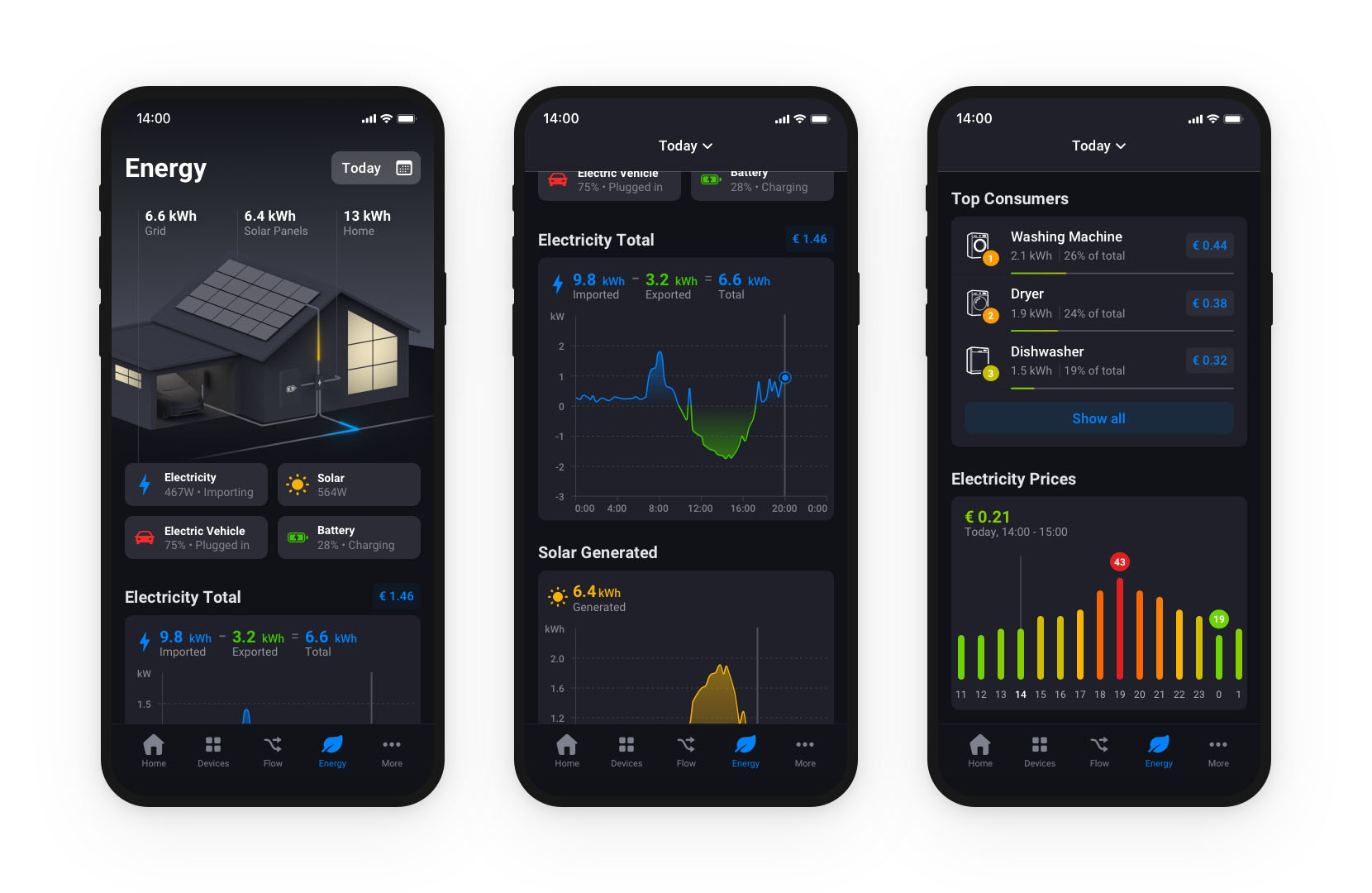
Connecting your inverter and solar panels to Homey Energy and using P1 data gives you a powerful control panel. You can see at a glance how much you consume, how much you produce, and which devices contribute the most. From there, you can build automation Flows that boost the heat pump on sunny days, throttle the EV charger when solar output is low, or let the home battery buffer energy during peaks and dips.
Automating a sustainable home with Homey also means more than just optimizing major appliances. Smart lighting can dim when fewer people are home, blinds can help reduce cooling loads, and sensors can detect when certain rooms are being heated unnecessarily. Everything you connect can contribute to a more comfortable, more efficient, less wasteful home.
Maximizing ROI Through Intelligent Energy Management
A sustainable home is an investment, and like any investment, the goal is to maximize the return. By using Homey Pro as a central Home Energy Management System (HEMS), you significantly shorten the payback period of expensive hardware like solar arrays and heat pumps. Rather than letting these systems operate in "silos" where they might inadvertently compete for power, Homey ensures they cooperate.
For example, a "Solar Awareness" Flow can prevent your heat pump from kicking into high-gear exactly when your EV charger is drawing maximum current, helping you avoid peak-shaving penalties or tripped breakers.
Beyond the financial savings, this orchestration reduces your carbon footprint by ensuring your "greenest" energy—the power generated on your own roof—is never wasted. As energy markets move toward more volatile pricing, the ability to automate your home’s response to grid carbon intensity or dynamic tariffs becomes a competitive advantage. With Homey, your home isn't just "smart" because it has gadgets; it’s intelligent because it actively manages your resources to be as lean, green, and cost-effective as possible.
The role of Homey Pro in a future-proof energy system
The energy landscape is changing fast. Price structures, feed-in tariffs, and new technologies shift constantly. In such a dynamic environment, it’s reassuring to have a system that can grow with you. Homey Pro is brand-agnostic and highly flexible, allowing you to add new hardware and integrations without replacing your entire setup.
If you start now by connecting your solar panels, integrating the P1 port, and automating a few key appliances, you build a foundation. Later, you can add a heat pump, an EV charger, or a home battery. Homey Pro remains the brain connecting all components. You don’t need to learn a completely new system — you simply expand what you already have.
This makes your home sustainable not only in terms of insulation and technology, but also in digital flexibility. Your home can adapt to the energy transition. Whether the focus of the coming years shifts toward dynamic tariffs, grid capacity limitations, or new storage solutions, a central, smart home controller makes every step easier.
FAQ
Do I need Homey Pro if I only have solar panels?
Not necessarily, but it makes it much easier to combine your solar production with consumption and automation. If you plan to add more sustainable devices in the future, Homey Pro is the ideal foundation.
Which devices benefit the most from integrating with Homey Pro?
Major loads such as heat pumps, electric boilers, EV chargers, and home batteries provide the largest impact. But smaller devices — like lighting, ventilation, and blinds — also contribute by helping manage heat and light intelligently.
Is it difficult to connect all these devices?
Homey Pro is designed to make pairing simple. Most devices are added via a dedicated Homey app, after which you can immediately use them in Flows. No programming required.
Does Homey Pro work without an internet connection?
Homey Pro runs locally. Most automations continue to function even without the internet, as devices communicate over your local network or wireless protocols. Only cloud-dependent services (such as some price feeds or remote APIs) require an internet connection.
How do I balance comfort and energy savings?
You define your comfort limits — temperature, lighting, ventilation — and Homey works within them. If you feel the system goes too far in saving energy, you can easily adjust your Flows.
Is Homey Pro future-proof as regulations and prices change?
Yes. Flows rely on logic, not on hard-coded tariff values. If circumstances change, you simply adjust the conditions, not the system. This makes Homey Pro highly adaptable.
Can I create seasonal scenarios?
Absolutely. You can make separate winter and summer Flows or build seasonal conditions into your automations.
How do I start if I’ve never automated anything?
Start with insight: connect the P1 port, your solar panels, and a few major appliances. Observe your energy profile in Homey Energy for a while. Then create one or two simple Flows and expand from there.
What does this ultimately deliver for me?
You gain more control, more comfort, and usually a lower energy bill. Plus, you’re better prepared for upcoming energy policy changes and new technologies. Your home becomes truly future-ready.
Glossary
Sustainable home
A home designed to be energy-efficient, comfortable, and future-proof, typically using solar panels, insulation, and smart technology.
Home Energy Management System (HEMS)
A system that monitors and controls household energy generation, consumption, and storage.
Integration
Connecting different devices and systems so they can work together and exchange data.
Comfort limit
The minimum or maximum settings (e.g., temperature or light level) that define a comfortable living environment.
Capacity limitation
A restriction on how much power a household may draw from or feed back into the grid, increasingly relevant due to grid congestion.
Grid congestion
A situation where the electricity grid in an area becomes overloaded, limiting additional consumption or feed-in.
Scenario
A predefined set of rules that adjust your home’s behaviour in certain situations, such as “vacation mode” or “summer mode.”
Local automation
Automation that runs on hardware inside your home, independent of cloud servers.
Energy system
All energy-related components in the home, including generation, consumption, and storage, plus the grid connection.
Future-proofing
How well your home and systems are prepared for future changes in energy, technology, and regulation.


