



Upgrading a Legacy KNX House with Homey
From “Old-School KNX” to a Modern Smart Home
Many legacy KNX homes were designed long before Zigbee, Matter, or phones full of smart home apps. The wiring is excellent. The devices are solid. But the user experience can feel stuck in another decade.
The good news: if you already have KNX, you’re not starting from zero. You have a professional backbone in your walls. Adding Homey Pro on top lets you keep that backbone and bring everything else up to date.
This spoke walks through a realistic upgrade path for a legacy KNX house, step by step, from “classic bus” to “modern hybrid system”.
Step 1 – Take Inventory of the KNX System You Already Have
Before adding anything, you need a clear picture of what’s there. That usually means:
- Exporting the ETS project from your integrator.
- Identifying which lines, power supplies and couplers exist.
- Listing the key group addresses for lighting, shading, heating and sensors.
Even if you don’t touch ETS yourself, having the project file and a readable list of group addresses is invaluable. It is effectively the “source code” of your KNX installation. At this stage, you’re not changing behaviour. You’re documenting it.
Step 2 – Add a KNX IP Gateway
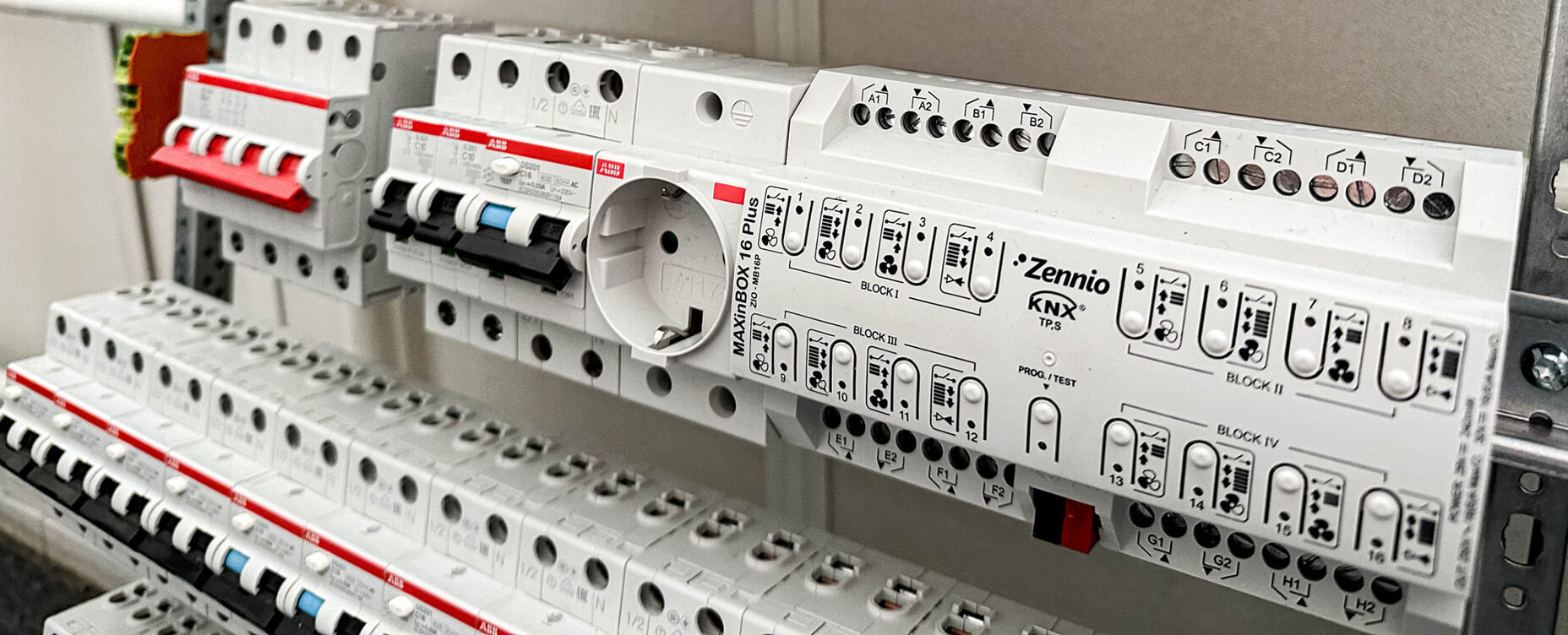
Next, you bridge KNX into your IP network with a KNX/IP interface or router. If you already have a KNX visualization server or remote access, there may already be one in your cabinet.
The gateway connects to the KNX TP bus and your Ethernet switch. From KNX’s point of view, it is just another bus participant. From your LAN’s point of view, it is a specialized IP endpoint that understands KNXnet/IP tunnelling.
Homey will later connect to this gateway. You don’t need to rewire or re-address the KNX side; you just give it a “door” into the bus.
Step 3 – Introduce Homey Pro as the KNX-Aware Homeserver
With the IP gateway in place, you install Homey Pro on the same network, add the KNX app, and point it at the gateway’s IP address.
At this moment, nothing in KNX changes. The classic KNX switches still control lights and blinds exactly as before. Homey is just listening and gaining the ability to send and receive KNX telegrams via the gateway.
From here on, you can gradually map KNX functions into Homey:
- Start with key lighting group addresses.
- Add shading, heating setpoints and a few sensors.
- Verify that toggling from Homey’s app produces the same result as your KNX switches.
You now have a dual view of your home: KNX as before, and Homey as a modern interface and automation engine.
Step 4 – Layer Modern UX on Top of Existing KNX Functions
Once core KNX functions appear in Homey, the experience changes dramatically without touching wiring.
You can control and see your KNX devices from:
- The Homey mobile app, web app and widgets.
- Voice assistants once you link them to Homey.
- Dashboards mixing KNX data with other devices.
Next, you can create simple Flows such as:
- “When I press a virtual ‘All Off’ button, turn off all KNX lights on the ground floor.”
- “When I leave home, close all KNX blinds and set heating to eco mode.”
You are not rewriting the KNX logic. You are wrapping it in a layer that is easier to evolve.
Step 5 – Start Mixing KNX with Wireless Devices
The real upgrade comes when you add non-KNX devices and treat them as peers.
Imagine:
- KNX actuators switching main circuits.
- Zigbee or Matter smart bulbs adding color accents.
- Z-Wave sensors providing presence or door status where KNX sensors were never installed.
- Wi-Fi devices such as cameras, speakers or appliances.
In Homey, these all appear in the same interface. A KNX window contact can now dim a Zigbee lamp. A Zigbee sensor can trigger KNX stair lighting. You’ve effectively extended your KNX house without running a single extra bus cable.
Step 6 – Migrate Logic Gradually, Not All at Once
For many legacy KNX homes, a lot of logic lives in the devices: central scenes, timers, basic automation. You don’t need to rip that out immediately.
A pragmatic approach is:
- Leave essential “always works” logic in KNX (e.g. local light toggles, frost protection).
- Add new, more expressive logic in Homey Flows.
- Over time, decide case by case which behaviors are easier to adjust in Homey than in ETS.
For example, you might leave local pushbutton–light links in KNX, but implement “vacation mode” or “evening scenes” entirely in Homey. If Homey is offline, your house still works; you just lose the extras temporarily.
Step 7 – Clean Up and Re-Document the Hybrid System
As you move from pure KNX to KNX + Homey, documentation matters again.
It pays to:
- Maintain an updated map of which functions are handled purely by KNX and which use Homey Flows.
- Keep a current list of group addresses and their meaning, especially those that Homey uses.
- Note any “virtual” concepts (modes, scenes) implemented in Homey that affect KNX behavior.
Think of it as version 2 of your house: same wiring, but a more capable brain on top.
Conclusion: Keep the Backbone, Upgrade the Experience
Upgrading a legacy KNX house with Homey is not a rip-and-replace story. It is a layering story:
- Keep the KNX bus and devices as the wired foundation.
- Add a KNX IP gateway and Homey Pro.
- Gradually bring KNX into Homey, then expand around it with wireless devices and cloud services.
The result is a home that keeps the robustness of KNX and gains the flexibility of a modern, app-driven, multi-protocol smart home — without losing control to a single proprietary ecosystem.
FAQ
Do I need to change my KNX cabling to use Homey?
No. Homey connects through a KNX IP gateway. Your existing twisted pair bus and wiring remain completely untouched during the setup.
Can I still use my existing KNX wall switches?
Yes. They continue to work exactly as they did before. Homey simply listens to and sends KNX telegrams alongside them on the same bus.
Will Homey break my existing KNX logic?
Not if you design your system sensibly. The core logic inside your KNX devices remains active while Homey adds additional layers of behavior on top.
Do I have to expose every KNX group to Homey?
No. You should start with the groups that are most useful for automation or remote control. You can always add more addresses later as your needs evolve.
What if my ETS project is missing or outdated?
You can still learn group addresses by monitoring the bus and toggling your physical devices. Having the original ETS project makes life easier but it is not a strict requirement.
Can Homey replace my old KNX visualization server?
In many cases the answer is yes. Homey provides a modern app and dashboard layer that can easily stand in for older or more restricted visualization tools.
Is there any benefit in moving existing KNX scenes into Homey?
Sometimes this makes sense. Scenes that cross protocols like mixing KNX with Zigbee or Matter are much easier to manage in Homey while purely KNX scenes can stay where they are.
Do I lose anything by not using a vendor-specific KNX server?
You gain vendor independence and a much wider multi protocol reach with Homey. Specialized vendor servers might offer unique niche features but they often come with the cost of ecosystem lock-in.
Glossary
Legacy KNX
Legacy KNX refers to an existing installation commissioned years ago with solid wiring and reliable devices. These systems often lack modern user interfaces or native integrations with wireless protocols. You can modernize them without replacing the hardware by adding a smart hub.
KNX/IP Gateway
A KNX/IP gateway is the essential bridge between the physical twisted pair bus and your home network. It uses the KNXnet/IP protocol to enable tools like ETS or Homey to communicate with your wired devices. It serves as the primary entry point for any modern IP based automation.
Mapping
Mapping is the specific process of linking your KNX group addresses and datapoint types to Homey devices. This step ensures that the hub understands if an address represents a simple switch or a temperature value. It is the most important part of the initial integration logic.
Visualization Server
A visualisation server provides the graphical interface used to control your KNX installation. Older servers are often vendor specific and can feel dated or restricted. Homey Pro can replace these legacy tools with a much faster and more intuitive mobile app.
Fallback Behavior
Fallback behaviour ensures that your home remains functional if the central hub goes offline. You should implement critical logic like light switching purely at the KNX level. This ensures that the physical wall buttons always work regardless of the network state.
Incremental Migration
Incremental migration involves upgrading your system in manageable stages rather than all at once. You can map a few essential group addresses today and expand the logic as you identify more needs. This approach reduces complexity and lets you learn the system at your own pace.


