


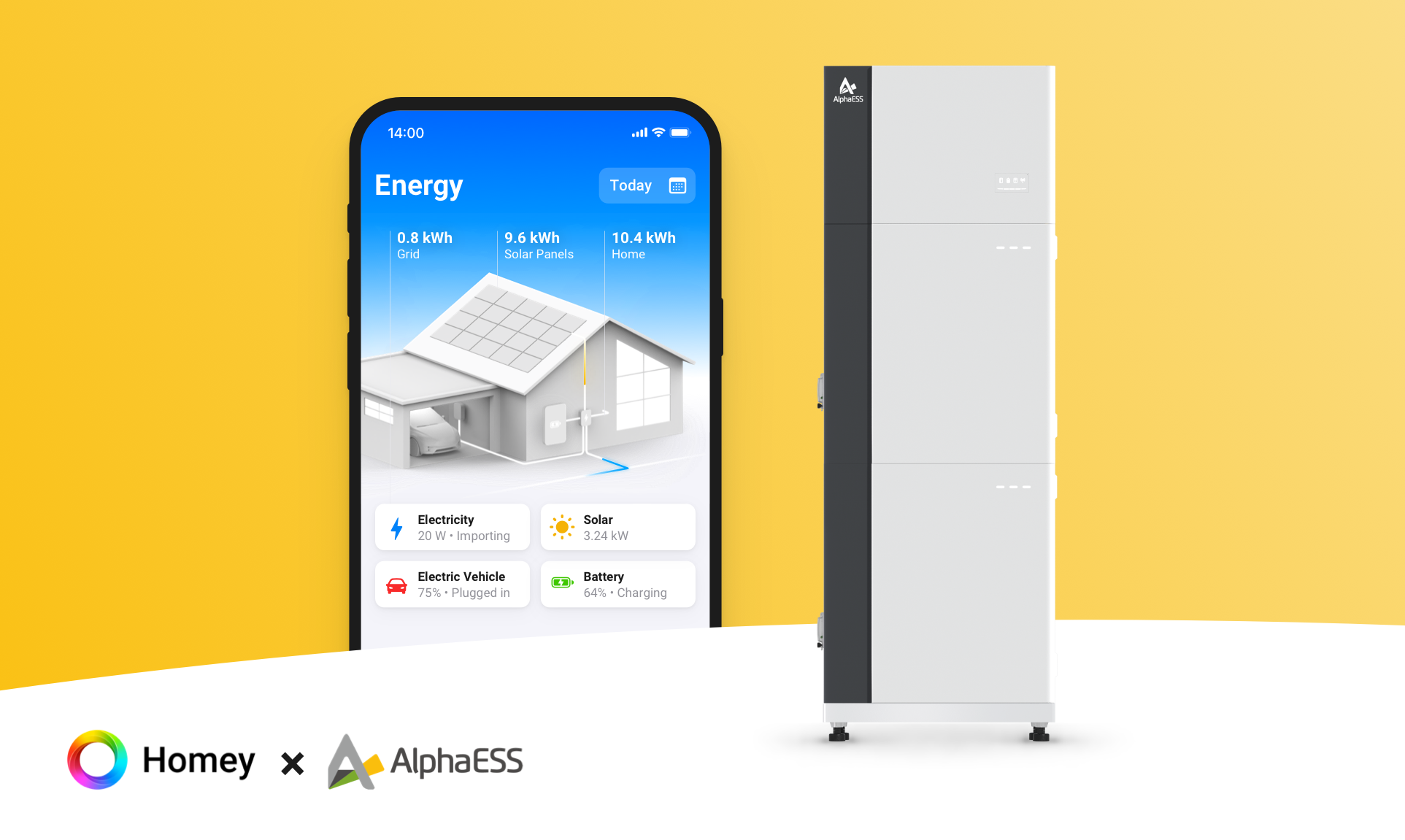





Smart EV Charging at Home with Homey
The electric car in your driveway is more than just transport. It’s also one of the largest pieces of flexible demand your home will ever have. A single full charge can equal several days’ worth of normal household consumption. That makes EV charging a critical part of any serious Home Energy Management System.
Without a HEMS, EV charging often follows a simple pattern: plug in, charge immediately at full power until the battery is full or the session is stopped. It’s straightforward—but it ignores dynamic tariffs, solar production and the state of the rest of the house.
Homey lets you treat EV charging very differently. It becomes a controllable, intelligent process that aligns with your energy strategy instead of working against it.
From “Always Now” to “Ready When Needed”
Most drivers don’t actually need their car to start charging the moment they plug it in. What they really need is for the car to be ready by a certain time, typically before the next commute. That difference—between “now” and “by then”—is exactly the flexibility your HEMS can use.

When you connect a compatible EV charger or car to Homey, you can teach Homey this logic. Instead of a fixed “on when plugged” behavior, you can define target times, minimum charge levels and preferred charging windows. Homey can then schedule charging in the background.
For example, if you regularly come home at six in the evening and leave again at seven the next morning, Homey sees a long window of opportunity. It can avoid the early evening when prices and grid load may be high, and focus instead on the cheapest or solar-rich hours later in the night.
From your perspective, nothing gets more complicated. You still plug in the car and go inside. Homey simply chooses the best times to actually move energy into the battery, based on your constraints and priorities.
Using Dynamic Tariffs to Your Advantage
With dynamic tariffs, the price of electricity changes every hour. This is particularly relevant for EV charging, because the volumes involved are so large. Charging a car during expensive hours can quickly become an unnecessary cost if cheaper hours are available.
By bringing price data into Homey, your HEMS can treat EV charging as a price-responsive load. You can set rules like “only charge when the price is below a chosen threshold” or “prioritise the three cheapest hours between now and departure time”. Advanced Flows even allow more nuanced strategies, such as combining minimum guaranteed charging with price optimisation.
The result is a charging pattern that is often invisible to you but very visible on your energy bill. Instead of guessing which hours are cheap, you let Homey make those choices consistently.
Aligning EV Charging With Solar Production
If you have solar panels, an even more attractive energy source becomes available: your own rooftop. Charging your car with self-generated power can be economically and environmentally compelling.
Homey can help you align EV charging with solar production by looking at inverter data or P1 smart meter readings. When it detects that your panels are producing more than your home is currently using, it can decide to route that surplus into the car’s battery.
In some setups, you might choose a “solar-preferred” mode, where the car charges primarily on surplus solar and only uses grid power when necessary to reach a certain level. In others, you might combine solar awareness with dynamic tariffs, favouring solar first but happily using cheap grid energy during particularly favourable hours.
Either way, your EV charger stops being a blind, fixed load and becomes a responsive part of your solar strategy.
Protecting Your Connection and Comfort
EV charging doesn’t happen in isolation. It shares your home’s electrical connection with all your other loads. In some households, starting the car at full power while other heavy consumers are running can push the connection close to its limit.
By linking P1 smart meter data with EV charging in Homey, you can prevent this. Flows can watch total household demand and reduce or temporarily pause charging if consumption climbs too high. Once the peak has passed, Homey can resume charging at an appropriate level.
This protects your main fuse, avoids inconvenient tripping and helps your home behave more politely toward the grid without requiring you to constantly monitor what’s happening.
EV Charging as a First-Class HEMS Citizen
When you look at EV charging through the lens of a HEMS, it stops being a separate concern and becomes a central lever. Homey’s role is to integrate your EV with prices, solar, household demand and your lifestyle.
The outcome is simple: you still wake up to a ready car, but you know that the energy that went into its battery was chosen wisely—at the right time, from the right source, and in a way that fits the rest of your home’s needs.
FAQs
How does Homey change the way I charge my car?
Without a HEMS, charging is usually immediate and "dumb"—it starts as soon as you plug in, regardless of cost or solar availability. Homey transforms this into an intelligent process, scheduling the charge for the optimal time based on your departure needs, energy prices, and solar production.
Can I charge my EV using only solar power?
Yes, or primarily so. Homey can monitor your solar inverter or smart meter to detect when you are producing more energy than your house is using. It can then route that specific surplus into your car’s battery, maximizing your use of free, self-generated power.
Will charging my EV trip my home's main fuse?
Not if you use Homey’s load balancing capabilities. By linking your P1 smart meter data with your charger, Homey watches your total household demand. If you turn on other heavy appliances, it automatically lowers the charging speed to prevent the connection from overloading.
Do I need to configure the charger every time I plug in?
No. You define your rules once—such as your usual departure time (e.g., 7:00 AM) or a minimum charge level. Homey handles the logic in the background, so you simply plug the car in and walk away, knowing it will be ready when you need it.
How do dynamic tariffs save money on EV charging?
With dynamic tariffs, electricity prices change hourly. Since an EV battery requires a large amount of energy, charging during expensive hours is costly. Homey automates this by treating the car as a "price-responsive load," only charging during the cheapest hours or when prices drop below a limit you set.
Glossary
Flexible Load
Any electrical device that consumes a significant amount of energy but does not need to run at a specific instant. EVs are the prime example: they require a lot of power, but the charging can be shifted to any time within a window (e.g., overnight) without impacting the user.
Dynamic Load Balancing
A safety feature that adjusts the power drawn by an EV charger in real-time based on the home's total energy consumption. It ensures the combined load of the car and household appliances never exceeds the limit of the main grid connection.
Smart Charging
The process of optimizing an EV charging session based on external factors rather than just plugging it in. These factors typically include electricity prices, the availability of solar energy, and the user's scheduled departure time.
Solar Surplus
Solar surplus occurs when your panels generate more power than your home currently needs, typically around midday. Rather than sending this excess back to the grid, your system identifies this overlap as a prime opportunity to trigger energy-hungry tasks automatically.
Dynamic Tariff
An electricity contract where the price per kWh fluctuates throughout the day, often based on wholesale market prices. This creates financial incentives to shift heavy energy usage, like EV charging, to off-peak hours.


