






Thread vs Zigbee, Z-Wave, WiFi and 433 MHz
Thread vs the Rest: You Don’t Need a Single Winner
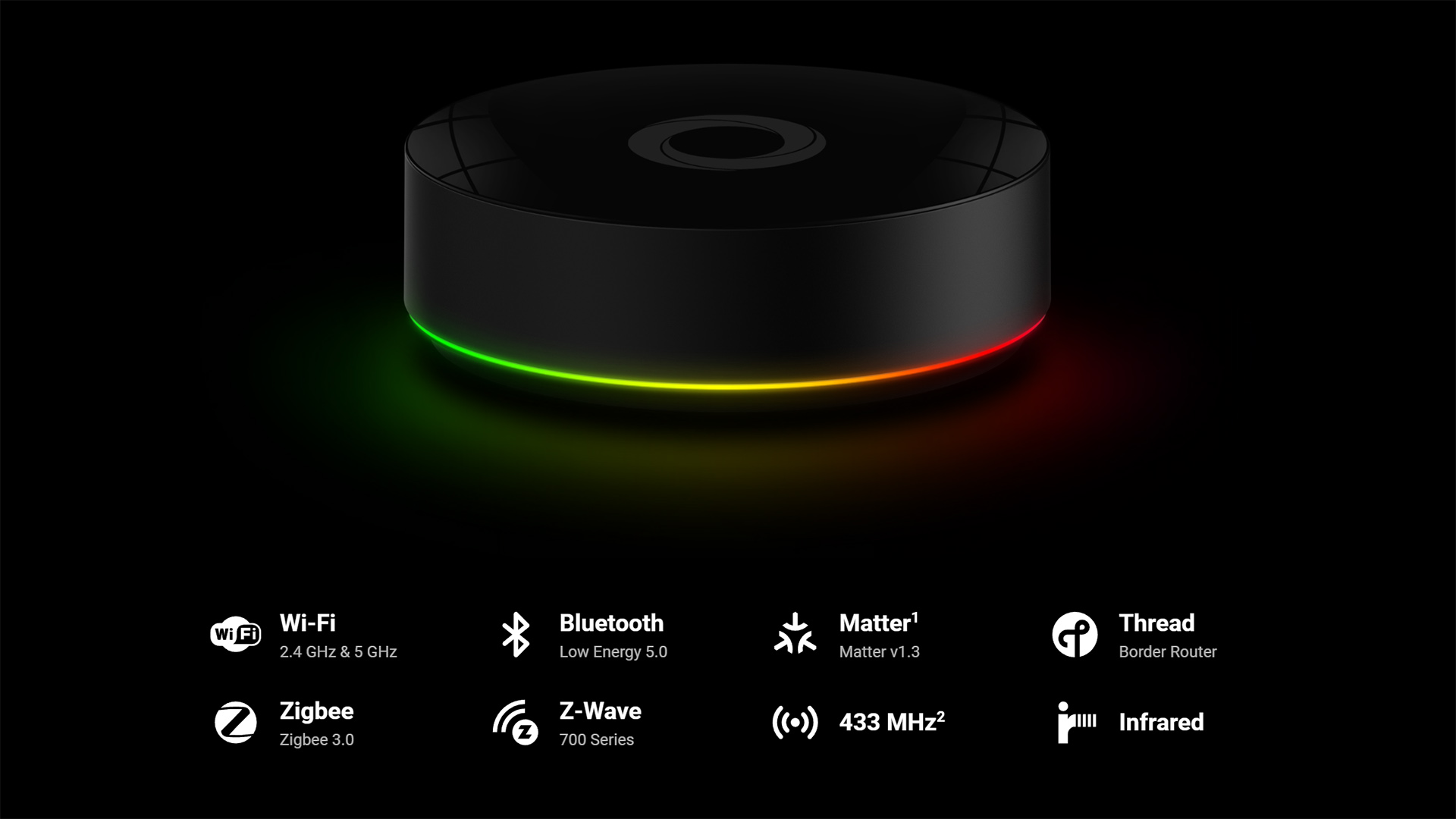
If you’ve been in smart homes for a while, your mental map probably looks something like this: Zigbee for bulbs and sensors, Z-Wave for locks and switches, WiFi for cameras, and 433 MHz for cheap, long-range remotes. Now Thread shows up with Matter labels and IP networking everywhere.
The natural question is, “Which one is best?” In practice, each protocol solves a slightly different problem. The smartest approach with Homey isn’t to pick a single winner, but to understand what each protocol is designed for and then assign the right jobs to the right tools.
Thread’s real differentiator is that it’s both IP-native and low-power. Zigbee and Z-Wave are excellent mesh networks, but they aren’t IP-based. WiFi is IP, but it's relatively heavy and power hungry. 433 MHz is simple, one-directional and not IP at all. Thread fits in between: a modern, secure mesh for small, low-power devices that still speaks IP end to end.
Thread vs Zigbee
Both Thread and Zigbee both run on IEEE 802.15.4 at 2.4 GHz. They use the same radios, but very different protocol stacks.
Zigbee defines its own network and application layers on top of 802.15.4. It is mature, well proven, and has a very large device ecosystem, especially for lighting and sensors. However, it is not IP-based, so gateways or smart hubs must translate between Zigbee and IP networks.
Thread takes a different approach. It carries IPv6 using 6LoWPAN, so devices participate in an IP network and routing follows standard IP concepts. Thread itself does not define device behavior. It focuses only on secure, reliable packet transport. Matter then sits above Thread, providing the device model and command definitions for things like lights, sensors, and locks.
On Homey, the practical view is:
- Zigbee: mature, lots of devices, great for bulbs and sensors you can buy today.
- Thread: newer, ideal for Matter-over-Thread devices, especially battery-powered ones.
With Homey as your smart home hub, you don’t have to migrate Zigbee away. You can simply start adding Matter-over-Thread devices alongside Zigbee.
Thread vs Z-Wave
Z-Wave operates in sub-GHz bands such as 868 or 915 MHz, which gives it good wall penetration and longer range per hop. It uses a mesh topology, has enforced certification, and has long been valued for predictable behavior in structured smart home setups.
What Z-Wave does not provide is IP connectivity at the edge. Like Zigbee, it relies on its own network and application stack, with hubs or gateways translating between Z-Wave devices and IP-based controllers.
Thread takes a different trade-off. It gives up some RF advantages, since 2.4 GHz is a busier band, in exchange for IPv6 support, modern silicon ecosystems, and tight integration with Matter. In a Homey home:
- Z-Wave remains strong for established products like wall modules, switches and sensors.
- Thread becomes attractive for new Matter devices and future-proofing.
With Homey, you can happily run both. There’s no penalty for mixing them when Homey is orchestrating.
Thread vs WiFi
WiFi is the default and easy choice for many vendors. Everyone already has it, and it can move a lot of data. But it’s not a great fit for small, low-power devices. It draws much more power, and filling a home network with dozens of tiny devices can add contention and unnecessary complexity.
Thread is deliberately not a replacement for WiFi:
- WiFi remains the right choice for cameras, doorbells, speakers, TVs, and anything streaming or bandwidth-hungry.
- Thread is right for tiny devices: contacts, sensors, switches, thermostats, TRVs.
With Homey, that split is natural: WiFi devices join via dedicated apps and integrations, while Matter-over-Thread devices join via the Thread mesh. Both end up in the same automation Flow canvas.
Thread vs 433 MHz
If Thread represents modern smart home design, 433 MHz represents the legacy end of the spectrum. Both still have a place, but they solve very different problems and are best used with clear boundaries.
433 MHz is almost the opposite of Thread:
- Usually one-way communication.
- Often no encryption, no authentication.
- Simple, cheap, and with excellent range.
It works well for basic remotes, inexpensive plugs, and legacy systems, which is exactly how Homey treats it: as a useful side channel for simple, low risk tasks.
Thread brings a very different model:
- Encrypted, authenticated mesh.
- Standard IP stack.
- Deep integration with Matter’s device model.
The goal is not to force everything off 433 MHz and onto Thread. It is to let 433 MHz remain where it makes sense, while moving new, security sensitive or long lived devices onto Thread and Matter.
Conclusion: Homey Keeps Everything Manageable
If you have ever tried to juggle five different smart home protocols directly, it would quickly become a headache. Each one has its own pairing methods, limitations, and quirks. Homey’s role is to absorb that complexity and present a consistent model on top.
- You add Zigbee, Z-Wave, Thread, WiFi and 433 MHz devices.
- Homey presents them all as unified devices with capabilities.
- Flows react to motion, contact, or switch events, not protocol specific details.
This abstraction is what makes mixing protocols practical. A motion sensor can trigger a light or a lock regardless of whether it uses Zigbee, Thread, or Z-Wave, because Homey handles the translation behind the scenes.
As a result, the real question shifts from “Which protocol should I buy?” to “For this device and location, which protocol’s strengths fit best?”
FAQ – Thread vs Other Protocols
Should I replace all my Zigbee gear with Thread?
No, there is no need. Zigbee devices can keep doing their job, and you can add Thread/Matter devices alongside them.
Is Thread always more reliable than Zigbee or Z-Wave?
In a well-designed network, all three can be very reliable. Thread’s advantage is IP and a modern security model, not magic RF communication.
Does Thread reduce WiFi congestion?
Yes, indirectly. By moving small devices off WiFi onto Thread, you free up WiFi airtime for the devices that actually need it.
Is 433 MHz obsolete now?
Not at all. It still shines for very simple tasks. It’s just not a secure, structured automation backbone.
Can I have Zigbee, Z-Wave and Thread in the same Homey?
Yes. Homey is built to run multiple radios at once and treat them as one integrated system.
Does Matter require Thread?
No. Matter can run over Wi-Fi or Thread. Thread is mainly for low-power devices.
Is Thread only for battery devices?
No. Router-class Thread devices are usually mains powered and are crucial for building a strong mesh.
Does Thread have better security than older protocols?
Yes. Thread mandates encrypted, authenticated networking, and when combined with Matter, it’s a big upgrade over unsecured 433 MHz or early Zigbee generations.
Glossary – Comparison Terms
Protocol
A set of rules describing how devices communicate. Zigbee, Z-Wave, Thread, Wi-Fi and 433 MHz signalling are all protocols at different layers.
IP-Native
A network that uses Internet Protocol (IP) end to end. Thread is IP-native; Zigbee and Z-Wave are not.
Mesh Network
A topology in which devices can forward messages for each other, increasing range and resilience.
Sub-GHz
Radio bands below 1 GHz, used by Z-Wave and some proprietary systems. Generally better at penetrating walls per hop.
Channel
A specific frequency segment within a band. Zigbee, Thread and Wi-Fi each use channels in the 2.4 GHz band but not the same ones.
Throughput
The amount of data that can be moved per unit of time. Wi-Fi has high throughput; Thread and Zigbee intentionally have low.
One-Way Protocol
A system where communication is mostly transmit-only (like many 433 MHz devices), with no acknowledgement or feedback.
Bridge
A device or software component that translates between different protocol worlds, e.g. from Zigbee or Thread to IP. Homey is effectively a multi-protocol bridge and controller.


