






How to Choose LED Lighting
Lumens, Watts and Color Temperature
Good lighting makes a big difference to how your home feels. With LED lighting, you can choose how bright a room is, how warm or cool the light looks, and how much energy your lights use.
Terms like lumens, watts, and kelvins can make choosing the right light bulb or LED strip seem more complicated than it needs to be. Once you know what they mean, it’s much easier to pick lighting that suits both the room and the way you use it. This guide explains the basics in plain terms and shows you how to choose the right LED lighting for each space in your home.
Why LED Is the Standard
LED bulbs use far less electricity than incandescent or halogen bulbs for the same amount of light. They also last much longer, so you replace them less often. And because LEDs turn more of their energy into light instead of heat, they stay cooler in use.
LEDs are flexible too. They come in many brightness levels, color temperatures, and shapes, and dimmable and smart versions make it easy to adapt your lighting to different moments of the day. The same room can feel bright and practical in the morning, comfortable during dinner, and calm in the evening.
Lumens vs. Watts
When you shop for light bulbs, the packaging usually lists several numbers. The two that matter most are lumens and watts.
People used to choose bulbs by wattage. A 60-watt bulb was brighter than a 40-watt bulb, so watts became an easy shorthand for brightness. That no longer works with LEDs. Because they’re so efficient, a low-wattage LED bulb can still produce plenty of light. To judge brightness, look at lumens instead.
Lumens Measure Brightness
Lumens (lm) measure the total amount of visible light a bulb produces. The higher the number, the brighter the light. Put simply, watts tell you how much power a bulb uses, and lumens tell you how much light it gives.
As a rough guide:
- Under 400 lumens for soft accent or mood lighting
- 400–800 lumens for general lighting in smaller spaces
- Over 800 lumens for brighter, more functional lighting
Treat these values as a starting point. A large room needs more total light than a small one, and several lower-output lamps often feel more comfortable than one very bright ceiling light. Personal taste plays a role too: some people prefer a softly lit living room, others like it brighter. For LED strips, brightness is usually listed per foot or per meter rather than for the whole strip, so take the length you need into account when you compare products.
Watts Measure Power Use
Watts (W) measure how much electricity a bulb uses. They don’t tell you how bright an LED bulb is. If two LED bulbs both produce 800 lumens and one uses less power, that one is more energy-efficient. Some packaging also shows this as efficacy in lumens per watt (lm/W): the higher the number, the more light you get for the same amount of energy.
If you’re used to incandescent bulbs, this table shows roughly how much power an LED bulb needs for the same brightness:
| Lumens | Incandescent | LED |
|---|---|---|
| 450 | 40W | 4–6W |
| 800 | 60W | 7–10W |
| 1,100 | 75W | 10–13W |
| 1,600 | 100W | 14–18W |
Halogen bulbs sit in between. They use about 30% less power than incandescent bulbs, but still far more than LEDs. The most efficient LED models can use even less than the values shown.
Exact values vary by product, but the principle is simple: choose brightness by lumens and use watts to understand energy use.
Color Temperature
Brightness is only one part of good lighting. The color of the light has a big influence on how a room feels. This is called color temperature, and it’s measured in kelvins (K). Lower values give warmer, more yellowish light. Higher values give cooler, whiter light. The right color temperature can make a room feel more relaxing, more practical, or more focused.
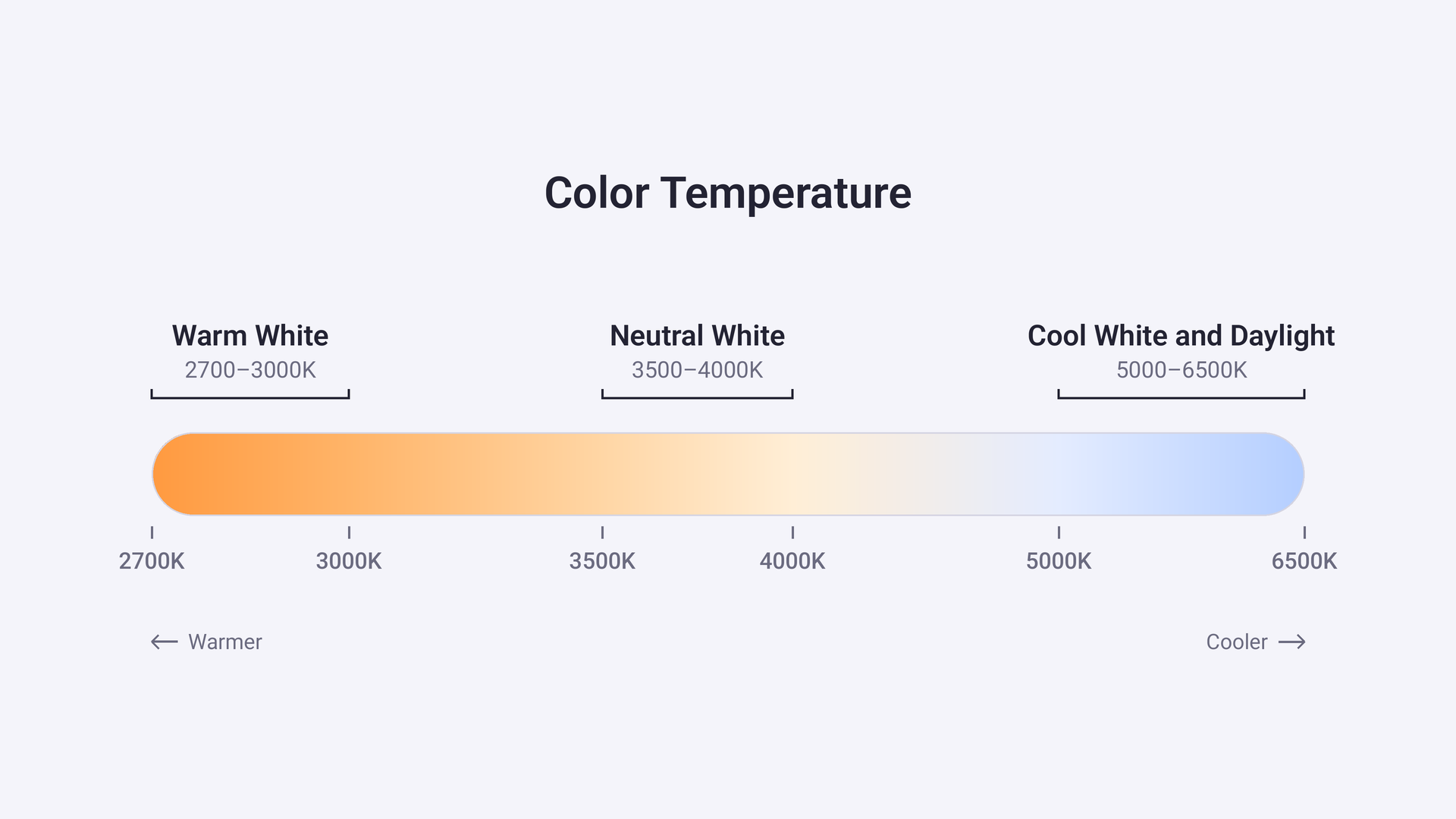
2700–3000K: Warm White
Warm white light feels soft and cozy. It’s close to the familiar glow of traditional incandescent bulbs and works especially well in rooms where you want to relax, such as the living room, bedroom, or dining area.
3500–4000K: Neutral White
Neutral white looks fresher and clearer without feeling cold. It’s a practical choice for kitchens, hallways, and home offices, where you need good visibility but still want the room to feel comfortable.
5000–6500K: Cool White and Daylight
Higher color temperatures produce a cooler light that can look brighter. This helps in workspaces, hobby rooms, and other places where you need to see details clearly. Very cool light is usually less suitable for relaxing in the evening.
A useful rule of thumb: warmer light for relaxing, cooler light for tasks and concentration.
Color Rendering (CRI)
Color temperature describes the color of the light itself. Color rendering describes how natural other colors look under that light. It’s expressed as the Color Rendering Index (CRI), on a scale up to 100. Most LED bulbs have a CRI of 80 or higher, which is fine for most rooms. In kitchens, bathrooms, and other places where you want food, skin tones, or fabrics to look true to life, a CRI of 90 or higher makes a visible difference.
Three Layers of Light
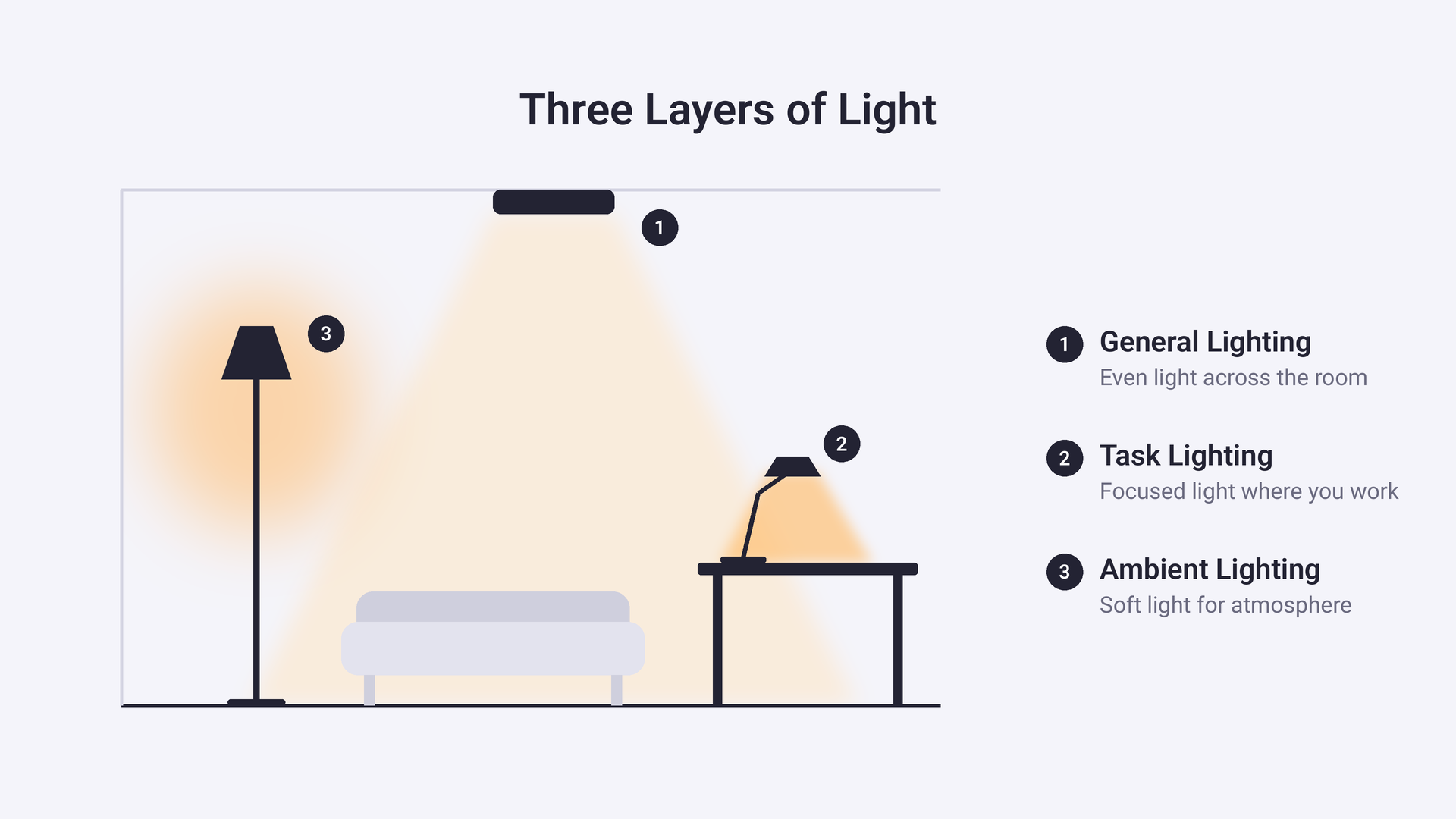
A comfortable lighting plan usually has more than one layer. By combining different types of light, you can make the same room work for different situations.
General Lighting
General lighting provides basic light across the whole room. It’s the light you switch on when you walk in and simply need to see where you’re going, usually from ceiling fixtures, recessed lights, or pendants. It doesn’t have to do everything by itself. In most rooms, general lighting works best as a foundation for the other layers.
Task Lighting
Task lighting adds light exactly where you need it, from a desk lamp or a reading lamp next to the sofa to an LED strip under the kitchen cabinets. Because it’s focused, task lighting helps you see clearly without making the entire room brighter than necessary.
Ambient Lighting
Ambient or mood lighting adds warmth and depth to a room. Table lamps, floor lamps, wall lights, and LED strips create softer pools of light, which is especially pleasant in the evening when you don’t need bright general lighting.
How Much Light per Room
There’s no single perfect amount of light for every home. Room size, wall colors, daylight, and personal preference all play a role. Start with what you usually do in the room, then combine general, task, and ambient lighting to suit it.
The table below gives a starting point for each room. The lumen values are per square foot (ft²) and per square meter (m²) of floor area, based on common residential guidance from the Illuminating Engineering Society (IES). To find the total amount of light a room needs, multiply its floor area by the value in the table. For color rendering, aim for a CRI of 90 or higher in the kitchen, dining room, and bathroom, and 80 or higher elsewhere.
| Room | Kelvin | Lumens per ft² | Lumens per m² |
|---|---|---|---|
| Living Room | 2700–3000K | 10–20 | 110–215 |
| Dining Room | 2700–3000K | 30–40 | 320–430 |
| Kitchen (General) | 3000–4000K | 30–40 | 320–430 |
| Kitchen Task Areas | 3000–4000K | 50–100 | 540–1,075 |
| Bedroom | 2700–3000K | 10–20 | 110–215 |
| Bathroom | 3000–4000K | 20–50 | 215–540 |
| Home Office | 4000K | 20–50 | 215–540 |
| Hallway | 3000–4000K | 5–20 | 55–215 |
Here’s how that works in practice. A 12-by-15-foot living room (about 3.7 by 4.6 meters) has 180 square feet, or about 17 square meters, of floor area. At 10–20 lumens per square foot (110–215 per square meter), it needs about 1,800–3,600 lumens in total. A 1,600-lumen ceiling light plus two 450-lumen table lamps gives you 2,500 lumens, spread across three sources you can use separately. Lampshades, dark walls, and high ceilings all absorb or spread light, so aim for the upper end of the range in those rooms.
Living Room
A living room serves many purposes. You might watch TV, read, talk with family and friends, or simply unwind at the end of the day. One central ceiling light rarely suits all of those moments, so combining several light sources gives you much more flexibility.
Use ceiling lights or recessed lights for general lighting, and add floor lamps, table lamps, or wall lights for softer light. Warm white light around 2700–3000K usually works well here. With dimmable or smart lighting, you can turn the brightness up when you need it and down later in the evening.
Kitchen
The kitchen needs light that’s both practical and comfortable. You need enough light to prepare food safely, read labels, and clean surfaces. At the same time, many kitchens double as social spaces where people eat, talk, or have coffee.
Ceiling lighting provides a good base, while under-cabinet lighting above the countertop helps you see clearly while cooking. A color temperature of around 3000–4000K works well in most kitchens, and slightly brighter, more neutral light improves visibility on work surfaces. Using several light sources also helps prevent shadows on the countertop.
Bedroom
The bedroom should help you rest, but you still need practical light now and then. A ceiling light helps when you’re getting dressed or tidying up, while bedside lamps are more comfortable for reading or winding down. Warm white light around 2700–3000K usually creates a calmer atmosphere.
Bedside lighting doesn’t need to light the entire room. A lower light output is often enough, especially when the lamp is close to you. With a dimmer, the same lamp works for both reading and relaxing.
Bathroom
Bathroom lighting needs to balance visibility, comfort, and safety. Ceiling lighting provides an even base, while lighting around the mirror helps with tasks like shaving, skincare, or applying makeup.
Light around 3000–4000K gives a clear view without feeling cold. Place mirror lights at the sides of the mirror or in front of your face rather than only above it, so they don’t cast shadows on your face.
Because water and electricity are close together in a bathroom, make sure every fixture is suitable for its location. In the US, fixtures are labeled damp-rated for most of the bathroom and wet-rated where water can reach them directly, such as inside a shower. In Europe, check the IP rating instead: IPX4 or higher is the usual minimum in the area around a bath or shower. Local rules vary, so check them before installing a fixture inside the shower area itself.
Home Office
Good lighting makes working from home more comfortable, especially when you spend hours looking at a screen. A desk lamp provides focused task lighting, while general lighting in the room reduces the contrast between your screen and its surroundings. A neutral color temperature around 4000K is often a good fit for focused work.
Pay attention to where you place your lights, too. Avoid glare on your screen and lamps that shine directly into your eyes.
Practical Lighting Tips
- Use several light sources instead of one very bright lamp. This gives a more even, comfortable result and more control over how the room feels.
- Combine direct and indirect light. Light that bounces off a wall or ceiling feels softer than a lamp shining straight into the room.
- Watch out for glare. Position lights so they don’t reflect in TVs, computer monitors, or windows.
- Plan for flexibility. Dimmable or smart lighting lets one room handle several activities without extra fixtures.
- Check dimmer compatibility. Not every LED bulb is dimmable. On a wall dimmer, use bulbs marked as dimmable and a dimmer that supports LEDs, or the light may flicker or buzz. Smart bulbs dim themselves, so connect them to a regular switch, not a dimmer.
- Choose the right fixtures for wet areas. In bathrooms and outdoors, make sure each fixture is rated for its location.
Lighting Through the Day
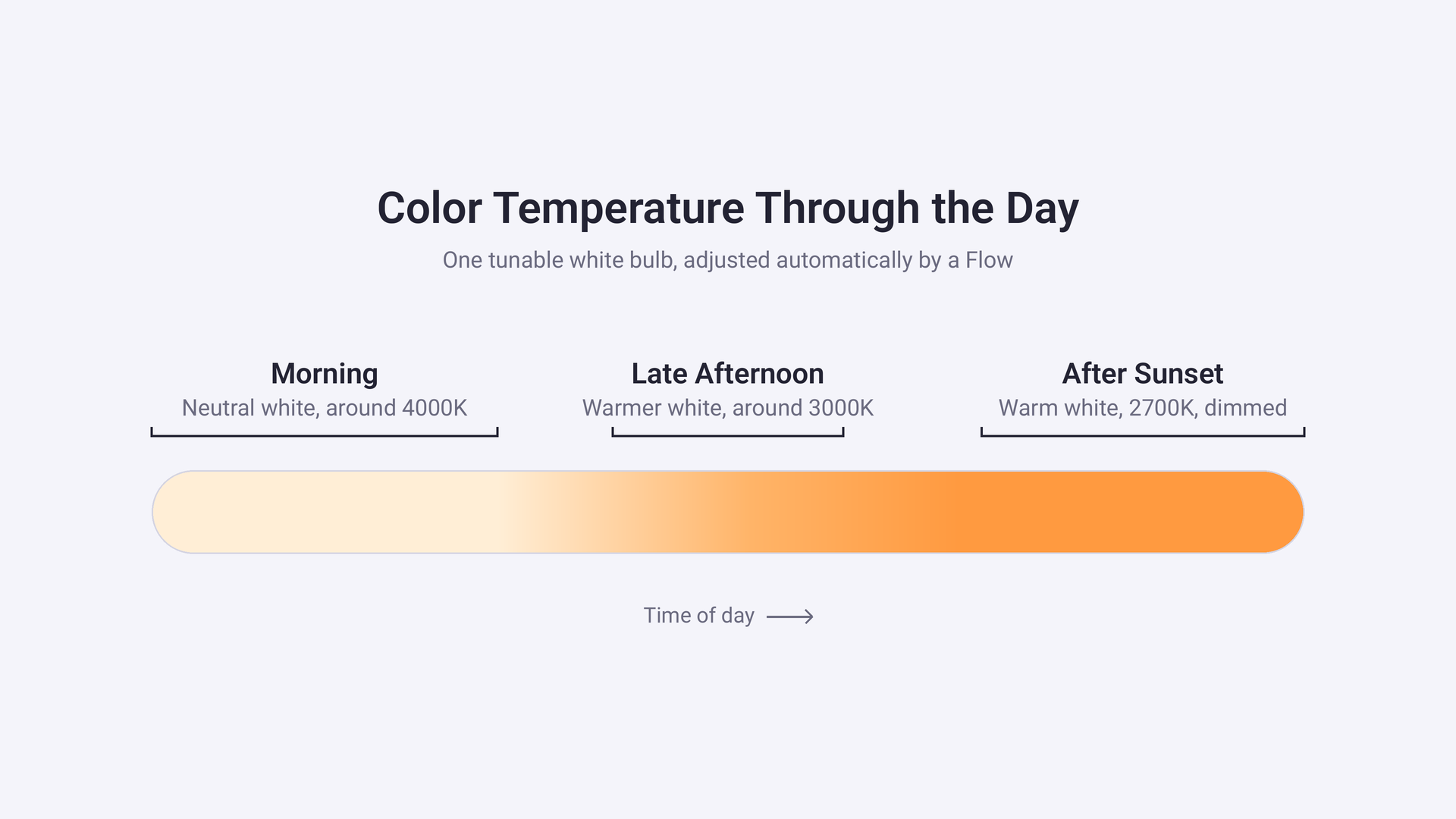
If you want neutral light for working and warm light for the evening in the same room, you don’t need two sets of bulbs. Smart bulbs with tunable white can shift between warm and cool white. Not every smart bulb can do this, so check that the bulb supports adjustable color temperature, often listed as tunable white.
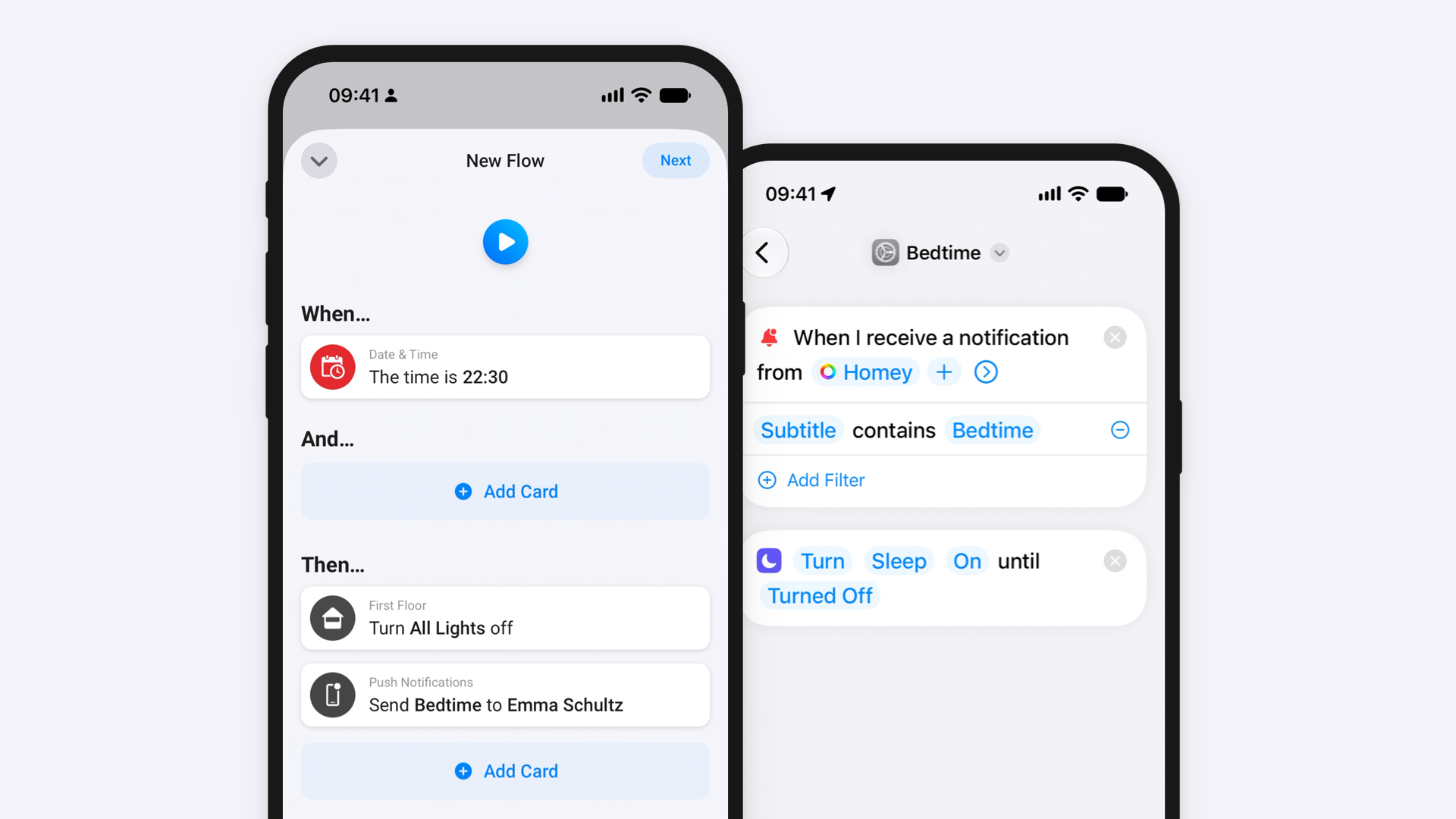
With Homey, a Flow can make that change for you. It could set your lights to a neutral white on weekday mornings, shift them to a warmer white in the late afternoon, and dim them to warm white after sunset. A “Movie night” Flow could dim the main lights and leave a few warm lamps on around the room with one tap.
Sensors help in places where you don’t want to look for a switch. With motion sensors, a hallway light can switch on at low brightness at night, so you’re not blinded on the way to the bathroom, and switch off a few minutes after the last motion. With door sensors, a closet or pantry light can turn on while the door is open.
One thing to keep in mind: a smart bulb needs constant power. If someone turns it off at the wall switch, Homey can’t reach it until the switch is turned back on. A wireless smart button that controls the bulbs without cutting their power avoids that problem.
Start With the Basics
Choosing good lighting is much simpler once you understand three things:
- Lumens tell you how much light a bulb produces.
- Color temperature, measured in kelvins, tells you whether the light looks warm or cool.
- The purpose of the room tells you how much light you need and where.
Get those basics right, and you can create lighting that feels comfortable, looks good, and uses energy efficiently. If you’re replacing bulbs anyway, consider tunable white smart bulbs for the rooms you use most. That way, you can adjust the color temperature later without buying new bulbs. Ready to choose? Compare smart bulbs and LED strips that work with Homey.


