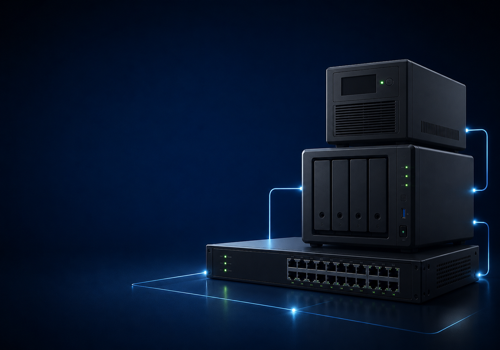




The point of a UPS is that Homey should act on a power cut, not merely survive it. This
app reads your UPS over the network and turns the moment mains power is lost into a Flow
trigger, while the battery still holds — so the non-essentials can go off and the NAS can
be shut down cleanly before the runtime is spent. It reads NAS boxes and managed switch
ports the same way. There is nothing to install on the equipment: everything goes over
SNMP, which they already speak.
Most home UPS units have no network card and sit on a USB cable behind a NAS, which is
exactly where the existing apps stop. This one reads that UPS through the NAS itself. One
honest limitation comes with it: the NAS is powered by the UPS it reports on, so it shuts
down partway through a long outage. Losing contact while the last known state was "on
battery" is its own Flow trigger, rather than a silent pretence that the power came back.
Fires once, at the moment a volume crosses the threshold upwards — not on every reading while it stays above. One card covers every volume: which one crossed comes back as a token, because Homey generates no Flow card of its own for a per-volume sub-capability.
NAS or host
The host reboots
i
Fires when the host's uptime goes backwards, which means it restarted between two readings. One caveat, said plainly: the host counts uptime in a 32-bit counter that wraps after about 497 days, and a wrap is indistinguishable from a reboot.
Switch port
The link comes up
i
Something was plugged in, or came back. Fires on the change, not on the state — a port that stays up does not fire again.
Switch port
The link goes down
i
The cable was unplugged, or the device at the other end went off. A poll that gets no answer does NOT fire this card — an unreachable switch makes the device unavailable instead, so a dropped SNMP packet never looks like an unplugged cable.
Switch port
The link state becomes State
Switch port
The PoE socket reports a fault
i
The switch says it cannot power this port — a short, an overload, or a device drawing more than its class. Only fires on switches whose PoE sockets the app could match to a port reliably.
UPS
The UPS switches to battery
i
Fires within about ten seconds of a power cut. This is the card to use for shutting non-essential devices down.
UPS
Mains power comes back
i
Only fires when the UPS itself says it is back on mains. If the UPS is relayed by a NAS that the outage switched off, the app cannot see the end of the outage — see the app description.
UPS
Contact is lost while on battery
i
A NAS that relays the UPS is itself powered by it, and switches off partway through the outage. This card says the outage lasted long enough for that to happen — the reported status stays on "battery" rather than pretending the power is back.
UPS
The battery becomes low
i
Uses the UPS's own low-battery flag, which follows the thresholds configured on the UPS — not a percentage guessed by the app.
UPS
Runtime drops below Minutes minutes
i
Fires on the crossing, once per outage, not on every reading below the threshold. Each Flow can use its own number of minutes.
UPS
The UPS is overloaded
i
Too much is plugged into the UPS. Fires once when the alarm appears, not on every reading.
UPS
The battery needs replacing
i
Fires once when the UPS raises the flag. A worn battery stays flagged for weeks, so this is not repeated on every reading.
UPS
The status changes to Status
그리고...
NAS or host
A volume is above Percent %
i
True when the fullest volume is above the threshold. Answers false when no volume could be read: a measurement that was not taken is not free space, and this card is there to guard a backup.
NAS or host
CPU load is above Percent %
i
The average over every core the host reports, not the first one. Answers false when the load could not be read.
NAS or host
Memory used is above Percent %
i
Careful with a low threshold: on Linux the figure counts cache and buffers as used, so a perfectly healthy NAS sits at 80–95 %. Answers false when memory could not be read.
Switch port
The link is up
Switch port
The PoE socket is delivering power
i
False when the app could not match a PoE socket to this port — it does not claim to know.
Switch port
The negotiated speed is above Speed Mbit/s
i
Answers false when the speed is unknown. A value that was not read is not a fast link, and it is not a slow one either.
UPS
The UPS is on battery
UPS
Runtime is above Minutes minutes
i
False when the runtime is unknown: an unread value is not a comfortable margin.
UPS
Battery is above Percent %
i
False when the charge is unknown, for the same reason.
그러면...
NAS or host
Read the host now
i
Takes the fast reading — load, memory, uptime — outside the normal schedule. Read-only, like everything this app does to a host: nothing here can switch anything off.
Switch port
Read this port now
Switch port
Switch the port State
i
Writes ifAdminStatus on the switch. Refuses, with a message saying what to enable, unless "Allow switching this port" is ticked in the device settings — read the warning there first: switching off the port that feeds your Homey or your router leaves no way back except physical access.
Switch port
Switch PoE power on this port State
i
Writes pethPsePortAdminEnable. Cuts the power to what is plugged in without disabling the port itself — this is the card for power-cycling a camera or an access point. Same guard as above: it refuses unless port control is enabled, and it refuses when the app could not match a PoE socket to this port rather than aiming at a guess.
UPS
Read the UPS now
i
Reads the fast group outside the schedule. The app never writes to the UPS: switching it off or starting a battery test would cut power to everything plugged into it, this Homey included.
버전 1.0.8 — A PoE socket could be matched to the wrong port, so switching it off would have cut power to a different device. The MIB does not say which port a socket belongs to, so the app now waits for proof — a socket drawing power must sit on a port whose link is up — and offers no PoE control until it has it. Also: the network sweep can no longer start twice at once, a NAS can no longer add an unbounded number of volumes, and the stored SNMP community is no longer shown in clear when repairing a device.