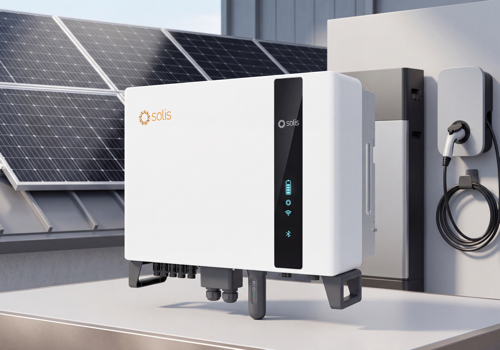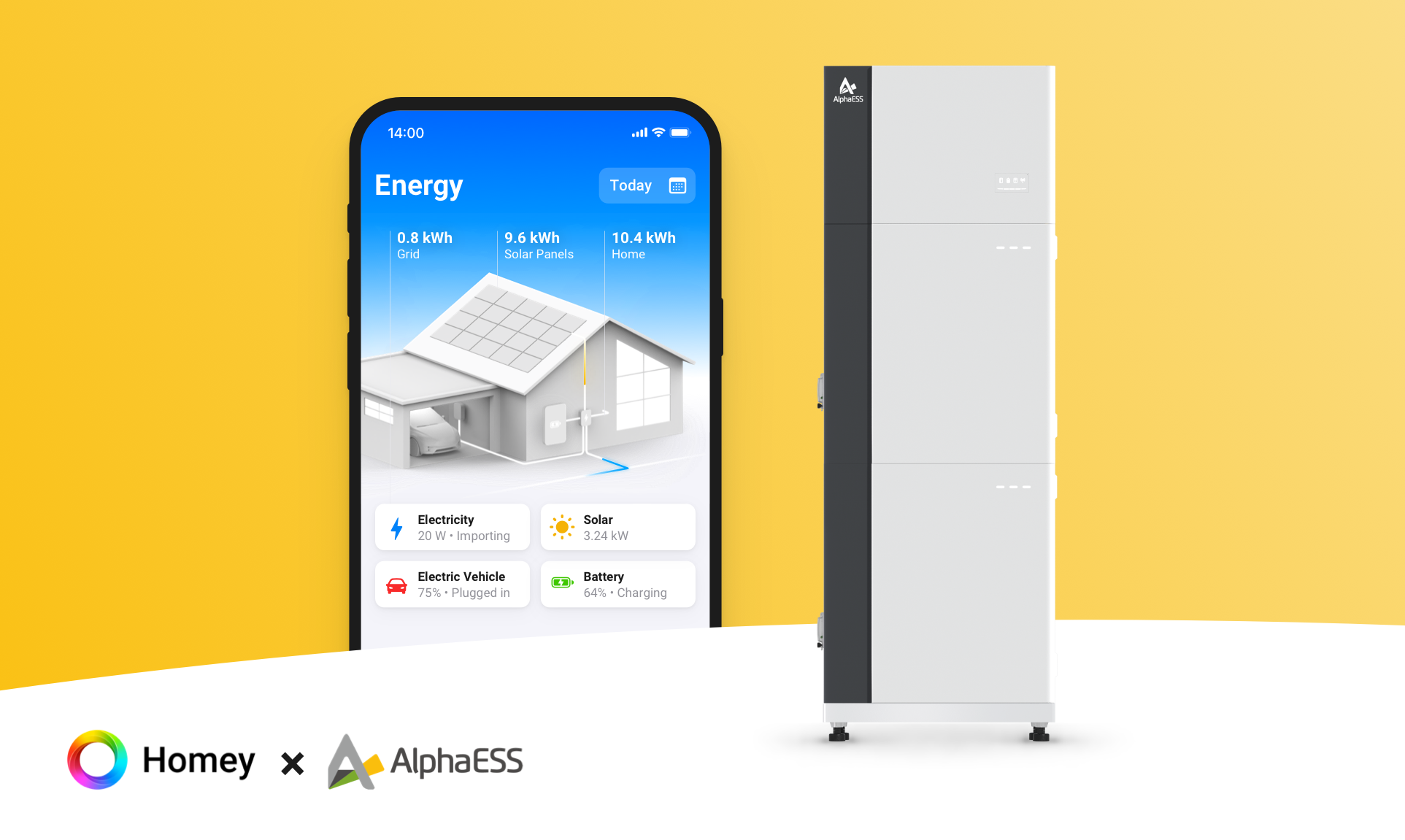




Guarda il tuo inverter solare ibrido e la batteria di casa direttamente sulla tua rete, senza che nessun account cloud entri in gioco. Il collegamento è un cavo RS485 alla porta COM dell'inverter attraverso un piccolo gateway da RS485 a Ethernet, così la produzione solare in tempo reale, il livello e la potenza di carica della batteria e la temperatura dell'inverter arrivano su un riquadro e nella dashboard Energia, mentre un totale di energia continuo continua a crescere anche dopo i riavvii.
È proprio questo gateway cablato che serve all'app: un modello che traduce Modbus TCP in RTU, con un indirizzo fisso sulla stessa rete di Homey e senza che un altro controllore parli con l'inverter nello stesso momento — Homey deve essere l'unico master sul bus RS485. Da lì le schede Flow reagiscono a una batteria scarica o a un picco di produzione solare, e Homey può anche controllare l'inverter e la batteria: caricare, scaricare, impostare la modalità di funzionamento e la riserva, e seguire i prezzi day-ahead. L'app non agisce mai da sola sull'inverter — tutto avviene tramite i Flow che crei o l'ottimizzatore di prezzo opzionale che attivi.
Clicca su un dispositivo qui sopra per visualizzare solo le schede dei Flow correlate.
Quando...
Solis Battery
Il livello della batteria è cambiato
Solis Battery
L'energia è cambiata
Solis Grid
L'energia è cambiata
Solis Inverter
L'energia è cambiata
Solis Inverter
Il misuratore di potenza è cambiato
Solis Inverter
Il voltaggio è cambiato
Solis Inverter
La temperatura è cambiata
Solis Inverter
Solar surplus rises above 1400 W
i
Fires when the power being exported to the grid (surplus PV the battery isn't absorbing) crosses above the set value. Use it to divert surplus into an EV charger or other load.
Solis Inverter
Follow-the-sun: charge at recommended current
i
Fires on each control tick while solar charging should run. The Recommended current token is the EV charging current to apply (e.g. to a Wattpilot).
Solis Inverter
Follow-the-sun: stop charging
i
Fires when the surplus is no longer enough to keep the EV charging above its minimum current.
Solis Inverter
Production becomes limited
i
Fires when the inverter starts reducing output — e.g. the grid voltage is too high (volt-watt curtailment), a power/export limit, or thermal derating. The Reason token says which. Adding local load (EV, battery) usually relieves an overvoltage limit.
Solis Inverter
Production no longer limited
i
Fires when the inverter returns to unrestricted operation after a limit clears.
Solis Inverter
Grid meter feed lost
i
Fires when the external grid-power feed (e.g. the Plugwise or Tibber meter) stops updating, so house load and self-consumption become unreliable.
Solis Inverter
Grid meter feed restored
i
Fires when the external grid-power feed resumes updating after being lost.
Solis Inverter
EV charge request fulfilled
i
Fires when the car reaches the requested charge level (or the request's deadline passes). Use it to notify or run a follow-up Flow.
E...
Solis Inverter
Production is limited
i
True while the inverter is deliberately holding its output below what the sun could deliver — a full battery, an export limit, or a high grid voltage or frequency. The device tile names the reason.
Solis Inverter
Solar output is limited
i
True while an export limit is active, so power is held back from the grid. Set or clear it with the export-limit actions.
Solis Inverter
Battery charge is below 20 %
i
Compares the battery's real charge level as the inverter reports it — not the reserve or the minimum you configured in the device settings.
Solis Inverter
Solar production is above 1000 W
i
This inverter's own panels only. Solar from a separate inverter that you feed in with 'Report external solar production' is not counted here.
Solis Inverter
EV charge request is active
i
True while a manual charge request is running — the optimizer is working toward the requested level by its deadline.
Poi...
Solis Inverter
Set work mode to ...
i
Switches the inverter's own operating mode. Self-use covers the house from solar and the battery first; Backup holds a reserve for a power cut; Off-grid runs the house from the battery alone. Leave it on Self-use unless you know you need another mode.
Solis Inverter
Grid charging ...
i
Only gives or withdraws PERMISSION to charge the battery from the grid — it does not start charging by itself. To actually charge, use 'Force charge battery' or let the price optimizer do it.
Solis Inverter
Force charge battery at 25 A up to 100 %
i
Charges the battery at the given current in amps, up to the chosen level. It holds until that level is reached or you stop it, and it is automatically trimmed so the battery and anything else drawing power can't together overload your connection.
Solis Inverter
Force discharge battery at 25 A
i
Discharges at a FIXED current in amps, whatever the house is using — so anything the house doesn't take goes out to the grid. To cover only what the house actually draws, use 'Cover the house from the battery' instead.
Solis Inverter
Cover the house from the battery, up to 5000 W
i
Discharges only as much as the house is actually drawing, so the grid sits at zero instead of exporting. Tracks your whole-home meter and adjusts every few seconds. Needs a live grid reading — feed one in with 'Report grid power' or poll a Plugwise Smile. Stops with 'Stop forced charge or discharge'. It follows your whole-home meter, so anything on that meter counts as house load — including an EV charger. If your car is charging, the battery will cover it too, up to the maximum you set here.
Solis Inverter
Stop forced charge or discharge
i
Ends any forced charge or discharge and hands the battery back to its normal behaviour, including the price optimizer if you use it.
Solis Inverter
Battery discharge ...
i
Blocks or allows the battery discharging into the house. Block it during cheap or medium price hours so the grid covers your loads and the pack keeps its charge, then allow it during expensive hours so self-use drains the battery to cover the house. Solar can still charge the battery while discharge is blocked.
Solis Inverter
Charge trim ...
i
Switches the advanced setting 'Trim battery charging to avoid grid import' from a Flow. Turn it off if your own energy manager needs the full charge limit back — for example to grid-charge the battery during the cheapest hours — and on again afterwards. The app's own charge actions already pause the trim by themselves, so you only need this for a controller outside the app.
Solis Inverter
Set battery reserve to 20 %
i
The backup reserve the inverter keeps for a power cut: in self-use it stops discharging here instead of running the battery down for the house. This is the inverter's own setting, separate from the minimum level and the safety floor in the device settings.
Solis Inverter
Limit grid export to 0 W
i
Caps how much power may flow to the grid. Set 0 W for zero export — the inverter then absorbs surplus into the battery and curtails solar to avoid feeding in. Useful while energy prices are negative. Requires a meter/CT; keep any other energy manager disconnected from the inverter.
Solis Inverter
Remove grid export limit
i
Turns the export limit off so the inverter can feed in to the grid normally again.
Solis Inverter
Switch inverter ...
i
Powers the whole inverter off or on (stops/starts solar, battery and grid exchange). A soft command for convenience — NOT a safety isolation: always use the physical AC/DC isolators and lockout before working on wiring.
Solis Inverter
Report EV charge power 7200 W
i
Feed your EV charger's live power to the price optimizer so it plans the battery around an active charging session and the two never overpower the grid connection. Trigger this from your charger's (e.g. Zaptec) 'power changed' Flow, passing its power tag.
Solis Inverter
Report external solar production 6500 W
i
For systems whose panels are on a different inverter: send that inverter's AC power here so the app knows the real solar production. Without it the app sees 0 W of solar and the home-consumption figure comes out far too low, or zero. It is used only to work out house load — your other inverter stays your solar source in the Energy dashboard, so nothing is counted twice.
Solis Inverter
Report grid power -200 W
i
Feed a whole-home meter reading (+ import / − export) to the self-consumption controller so it can trim battery charging to avoid grid import. The inverter's own meter is blind to house load, so trigger this from your grid meter's (e.g. Tibber Pulse) 'power changed' Flow, passing its power tag.
Solis Inverter
Report house load 600 W
i
Feed your true house consumption (excluding the EV charger) to the price optimizer as the load signal, instead of the PV/battery/grid-derived estimate. Trigger this from your home energy meter's (e.g. a P1 dongle or a Shelly EM) 'power changed' Flow, passing its power tag. Falls back to the derived load if it goes stale.
Solis Inverter
Limit solar output ...
i
Throttles solar production down (on) or returns to normal (off) — the same switch as the Limit solar output tile. The inverter holds back its output so it stops pushing power out. Pair it with a whole-home meter in a Flow to curtail only when you're actually exporting (e.g. when prices are negative). Pauses while another energy manager holds the connection.
Solis Inverter
Charge EV to Charge level (%)% within Within hours h
i
Asks the price optimizer to have the car at the given charge level within the given time. It picks the cheapest/greenest slots to reach the target by the deadline, alongside any scheduled trip and surplus solar charging. Needs the price optimizer configured and the EV charger reachable.
Solis Inverter
Cancel EV charge request
i
Clears an active manual EV charge request so the optimizer stops working toward it and the charger reverts to its normal behaviour.
Solis Inverter
Fill battery then charge EV to EV charge level (%)%
i
For a cheap day: the price optimizer grid-charges the home battery to 100%, then starts charging the car to the chosen level. The car is held off until the battery is full so they don't compete for the connection. Stop it any time with the stop action. Needs the price optimizer configured and the EV charger reachable.
Solis Inverter
Stop cheap-day fill
i
Stops the cheap-day fill campaign (battery then EV) and hands control back to the price optimizer's normal plan.
Supporto
Hai un problema con questa app?
Contatta lo sviluppatore qui.
Novità
Versione 0.1.82 — - Fixed: stopping a forced charge or discharge could report success when part of it had actually been refused by the inverter. Failures are now reported instead of hidden.
- Improved: when the inverter refuses a command, the error now says why and names the setting it refused, instead of only showing a number. On some inverter models a few commands are simply not supported, and this makes that visible.