






Battery Charging with Dynamic Prices & Homey
You turn on the kettle and Homey quietly nudges your household: prices are dropping in five minutes. While you pour your tea your home starts charging the battery. It slightly advances the dishwasher and holds off your EV charger a bit longer. There are no charts or manual scheduling involved. You set the rules and Homey orchestrates everything right when electricity is at its cheapest.
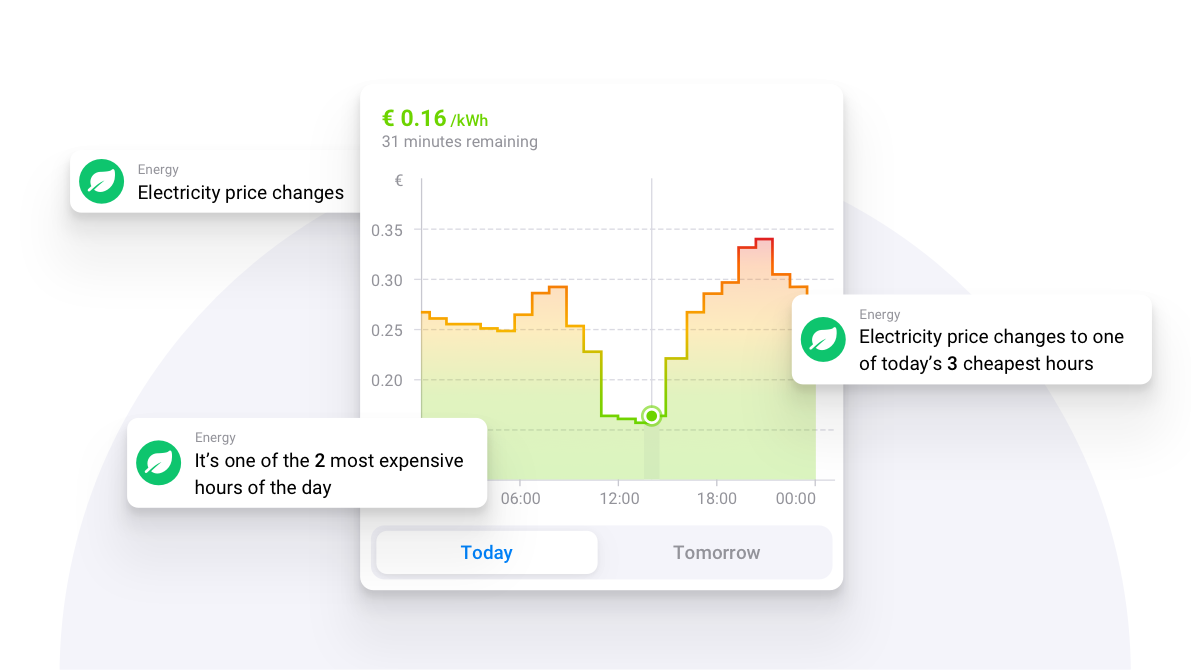
Dynamic pricing makes this possible. Instead of one fixed rate you get prices that follow the wholesale market and are published a day ahead. Dynamic contracts show the price per block which enables precise automation. Regulators explain that these rates vary so your costs fluctuate. Therefore, you need flexibility to benefit from this system which is why automation becomes essential.
Why Cheapest Quarter Hours Suddenly Matter
Many markets have moved from hourly to quarter-hour auctions. This change means there are 96 pricing windows a day instead of 24. It sounds technical but simply means more opportunities for cheap or even negative prices during sunny or windy moments. It is pure gain when you can charge or buffer then.
Prices are set at electricity exchanges based on supply and demand. They confirm that prices can go negative which is a market signal of oversupply. That is not a quirk for households with dynamic contracts but an opportunity. You can charge your home battery, heat pump boiler or EV precisely then. You should avoid feeding back into the grid during these windows as some contracts might even charge you for that.
Directing from Price Signals to Smooth Actions
You do not need to become an energy trader to make use of dynamic prices. You simply define what should happen in your home with Homey Pro. Your battery charges when the price drops below your threshold or your solar power is high. Charging stops and usage or comfort takes priority when prices rise or the sun sets. You are not tweaking dials but setting boundaries while Homey stays on track.
Start with insights. The P1 port on your smart meter gives real-time usage and energy feed-in data. You can see your baseload and peaks along with live feed-in via Homey Energy using the Homey Energy Dongle. The P1 interface is standardized and galvanically isolated for safe readings. The dongle also includes a splitter which is handy if you also use load balancing for your EV charger. This way your Homey Flows respond to both pricing and real-life conditions in your home.
Auto Charging Your Battery in the Cheapest Moments
Start with the two anchors of price and comfort. You can say in a Flow that the battery should charge to a target SoC if the price is below a threshold. That SoC is your daily charge level which might be 80 to 90 percent to avoid sitting at 100 percent too long. Add a second rule for evenings to discharge to a minimum SoC when needed if the price is above a threshold. Your battery shifts energy from cheap to expensive hours which is where savings happen.
Add a condition to prefer charging during feed-in if you have solar panels. That boosts self-consumption and makes you less dependent on uncertain feed-in tariffs. You can also run appliances like the washing machine or dishwasher during those windows using a smart plug. You will use both cheap and self-generated energy. Experts confirm you should consume as much of your solar power yourself and be cautious about feeding in during negative prices.
Finding Perfect Allies in EVs and Boilers
Your EV charger is your biggest buffer if you drive electric. To save energy, you define a rule in Homey to charge only during cheap or sunny moments. You are never caught empty but still benefit from bargain hours. You can let load balancing scale back charge speed briefly thanks to real-time P1 data.
A heat pump boiler or buffer tank is another great partner. Charge heat during low prices and use it later. It is a comfortable buffer ideal for short cheap windows because heat dissipates slowly. Grid operators show that this type of smart shifting lowers overall grid peaks when many homes use time-based automation.
Being Realistic about Efficiency and Lifespan
A home battery is not magic. Charging and discharging always loses some energy since modern lithium-ion systems achieve about 85 percent round-trip efficiency. That is why Homey targets meaningful shifts rather than micro-tweaks. Use bandwidths. Charge to a target SoC for evening use and discharge only when price or demand makes it worth it. Avoid sitting long at zero or 100 percent. It is all about balancing savings with sustainability.
Dealing with Negative Prices
Negative prices are the perfect time to fill useful buffers like your EV or boiler or battery. You can add a rule to your Flow to maximize charging within safe limits if the price is below zero and comfort is maintained. This helps avoid feed-in during costly moments and flips the market logic in your favor. Electricity exchanges explain that negative prices are not errors but signs that storage and flexibility are growing in value.
Staying Safe and Reliable under Your Control
Your energy automations runs locally on Homey Pro which makes it fast and reliable as well as cloud-independent. You see exactly what is happening in Homey Energy regarding baseload and peaks. The P1 readings are galvanically isolated and compliant with standards. You connect supported devices such as smart plugs and thermostats along with EV chargers and home batteries to build your smart energy setup step by step.
Starting Today
Connect the Homey Energy Dongle to your utility meter and observe a week’s worth of patterns. See when you feed in and when prices spike or dip. Set one charge threshold for your battery and one stop condition. Add your EV charger and boiler as second and third buffers. Use departure times and temperature bands to prioritize comfort. You will see the effect in Homey Energy after a few days with more usage in cheap blocks and lower evening peaks.
FAQs
How do I know when a cheap quarter-hour is coming?
Your provider publishes prices per hour or quarter-day in advance with dynamic contracts. Homey pulls this via your provider’s app or a supported integration. You can build Flows that respond automatically when prices drop below your set threshold.
Do I need a dynamic contract to benefit from cheap quarter-hours?
Yes. Fixed or variable contracts do not change pricing per quarter or hour. Only dynamic contracts reflect the market price daily. This lets Homey respond to cheap or negative pricing moments.
How does Homey prevent my battery from overcharging or over-cycling?
Homey works with target and minimum SoC bands. It only triggers charging or discharging on meaningful price differences to avoid unnecessary micro-cycles. That protects your battery and keeps automation efficient.
Can I charge based on both price and solar conditions?
Yes. You can combine conditions. For example you can charge only when price is low and you are feeding in via the P1 meter. That way you benefit from cheap grid power and your own solar surplus.
What happens if I feed in during a negative price window?
You actually pay to feed in with some dynamic contracts. Homey can respond by maximizing own use and charging buffers if the price is below zero. Your battery and EV and boiler then absorb excess instead of sending it back.
Can my EV charge automatically in cheap quarter-hours?
Yes. Homey supports many EV chargers. Set a minimum SoC and departure time so your car is always ready. Homey then charges during the cheapest quarters within those boundaries.
How does the P1 meter help with dynamic pricing?
Begin with visibility. Connect the Homey energy dongle and observe your data for a few days. Then build a simple price based Flow for your battery. Expand with your EV charger or boiler once you are confident in how automation works.
What’s the easiest way to start with dynamic pricing and Homey?
The P1 port shows Homey your actual feed-in and usage. This lets your Homey Flows react to real conditions in your home rather than just prices. Your charger can automatically throttle back if your connection nears overload.
Glossary
Quarter-Hour Settlement
A market mechanism where electricity prices are set every 15 minutes rather than hourly. This allows for more precise response to fluctuations in renewable energy supply.
Negative Prices
A market situation where the electricity price drops below zero due to high supply and low demand. This effectively means you are paid to consume energy.
Round-Trip Efficiency
The percentage of electricity put into a battery that can be retrieved later. Some energy is naturally lost as heat during the charging and discharging process.
Load Balancing
The process of distributing available power across multiple devices to prevent overloading the main electrical connection.
Galvanic Isolation
A safety design feature in electronics that separates electrical circuits to prevent stray currents. It ensures the safe connection of devices like energy dongles to smart meters.


