






Using Dynamic Energy Prices with Homey
Dynamic energy tariffs turn electricity into something that changes value every hour. Instead of a single fixed price, you get a stream of prices that reflect reality on the grid: plentiful wind and sun in one hour, scarcity in another.
For many households, that variability feels like a risk: “what if I accidentally use a lot during an expensive hour?” But with Homey as the heart of your HEMS, it becomes an opportunity. You can let your home adapt to price signals automatically, without constantly checking an app.
From Flat Rates to a Home that Moves with the Market
You turn on the kettle and glance at your phone to see the electricity price has just dropped. While you pour your tea, your home starts the washing machine. Your EV charger lowers its charging current a bit and the boiler begins to pre-heat. This happens not because you are staring at apps every hour but because Homey recognizes the price signals and acts automatically within the boundaries you have set.
That is the preface of dynamic energy prices. Your consumption shifts to the cheapest moments without hassle and with full comfort.
In this article, you’ll read what dynamic energy prices are, why they’re becoming more relevant, what opportunities and risks they bring, and how you can extract real value from them with Homey. We keep it level-headed and evergreen: serious sources, no made-up claims, and practical tips that will hold up for years.
What Dynamic Energy Prices Actually Are
Your home electricity tariff follows the wholesale market with a dynamic contract. In most cases, you get a different price per hour which you can see one day in advance while gas usually has a daily price. That gives you predictability to plan and automate.
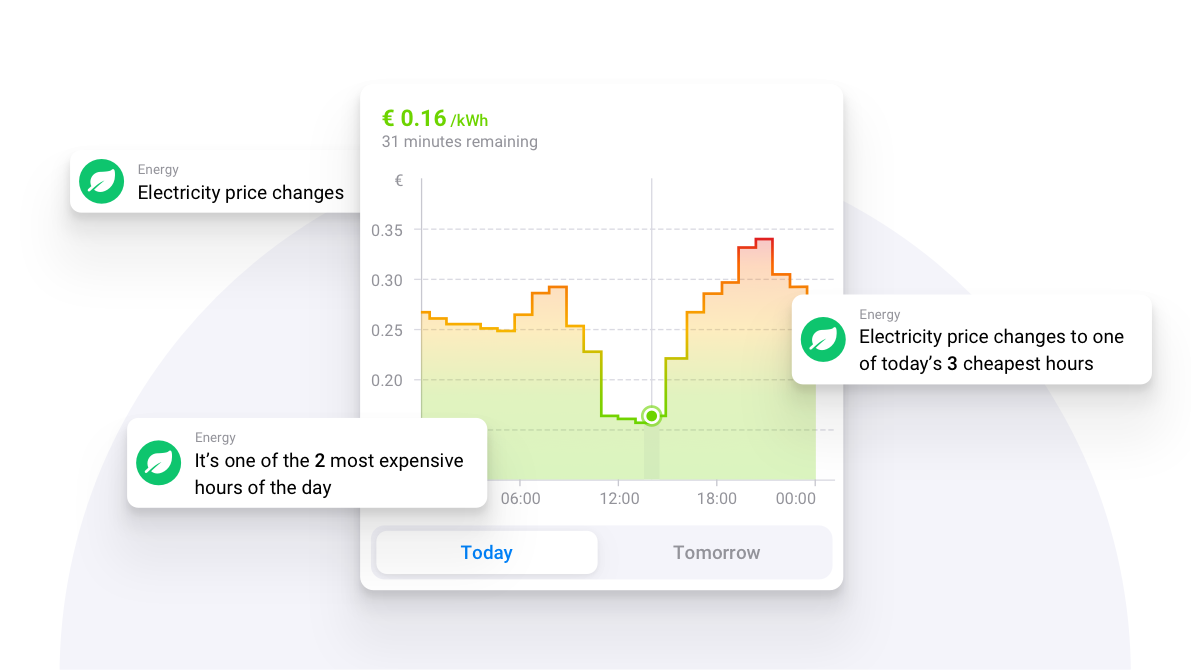
Energy regulators allow customers with a dynamic contract see the price ladder for tomorrow each day. Consumer information desks clarify that the difference between fixed and dynamic tariffs is that the electricity rate can change per quarter hour or per hour depending on the provider and service.
The big advantage here is that you can benefit immediately when prices are low. The downside is that you pay more during peaks if you do not change anything.
These day-ahead prices arise on energy exchanges like EPEX Spot by matching supply and demand. Prices can even turn negative at moments with lots of sun and wind combined with little demand. In theory, you would even have to pay to feed power back into the grid. Those episodes are not everyday occurrences but they happen more often thanks to the growth of renewable generation. That underscores the importance of flexibility and automatic control of energy management at home.
Turning price into a signal your home understands
The first step is to bring price data into Homey via a compatible integration. Once that’s in place, the price per hour becomes just another piece of context, alongside time, presence and device status.
From Homey’s perspective, the electricity price is like a slowly moving sensor value. Sometimes it’s low, sometimes it’s moderate, sometimes it spikes. That’s ideal, because Flows and Advanced Flows are designed to act on such changing conditions.
You don’t need to know every price yourself. You only need to decide what “cheap”, “normal” and “expensive” mean for your situation, and which devices are allowed to respond.
Why This Matters More Than Ever
Our energy system is shifting more and more towards renewable energy. As a result, we see cheaper blocks with lots of supply alongside expensive peaks with high demand. At the same time, grid operators and policymakers are looking for ways to spread and even out the pressure on the electricity grid.
Research commissioned by grid operators shows that time-dependent tariffs can help households spread their consumption more favorably over the day. For you, this mainly means that anyone who can shift in time gets more opportunities to save while helping to relieve the grid.
Those opportunities are not just for energy experts. It is surprisingly accessible to let your home respond to tariff fluctuations with a central home energy management system. And that is where Homey comes in.
Insights and Control with Homey
Smart automation starts with knowing what is going on. The P1 port on your smart meter is your live data source. Plug the Homey energy dongle into the P1 port and Homey Energy instantly shows your current energy consumption. It also displays any feed-in to the grid and your gas usage if your meter provides it.
That insight is not an end in itself but rather your trigger. You can build Homey Flows that respond to real conditions.
- Price below your threshold.
- Feed-in above X watts.
- Nobody is at home.
- A combination of these factors.
Homey Pro acts as the local brain of your smart home and ensures it runs reliably. This local processing is crucial for making split-second switching decisions even if your internet connection fails. You can easily integrate diverse hardware ranging from smart plugs and thermostats to EV chargers and solar inverters. Your smart home hub becomes the central meeting point where dynamic prices and energy generation merge seamlessly with your storage and consumption.
Making Your Home Move with the Market
Imagine you have a dynamic energy contract and solar panels. Tomorrow’s cheapest hours are around noon which is exactly when the sun is strongest. Instead of setting separate timers per device, you define and automate "cheap power hours" in Homey.
- You let shiftable loads like the washing machine or dryer automatically start within the cheap window.
- Your EV charger waits for a favorable hour price but always reaches your minimum state of charge before departure.
- Your heat pump boiler works thermally ahead of time by heating the tank slightly higher during the day.
- A smart plug can cut power to the media cabinet or home office corner if the price unexpectedly spikes.
The magic is not any single rule, but rather the combination of price and generation with comfort and schedule in one coherent set of Flows. You are still in charge with manual control and exceptions to safeguard home comfort.
Prioritizing Comfort Without Sacrifice
Many people worry that saving energy results in a cold house or an uncharged car. The solution is to define strict comfort boundaries. You set minimum and maximum temperatures per zone in Homey along with specific time windows for heating. You also configure a departure time and minimum battery level for your vehicle. You can even define quiet hours so noisy appliances do not disturb your peace.
Your energy logic works within these limits to exploit cheap hours. Your home stays comfortable while the savings accumulate automatically. Experts emphasize that dynamic contracts are most effective when you shift consumption. Automation allows you to achieve that shift without daily effort. You can see the actual impact in Homey Energy as your baseload and peaks become easily visible.
Handling Negative Prices
Consuming energy becomes profitable during periods of negative electricity prices while feeding back into the grid is unfavorable. With Homey, you can use these moments to top up your EV or home battery.
Environmental agencies explain that contracts with hourly tariffs sometimes include periods where you can even pay to feed in electricity back to the grid. By steering smartly with Homey, you can also avoid this entirely.
In practice you mainly treat these moments as a bonus.
- You charge a bit of extra energy into useful buffers.
- You avoid feeding power back when it costs you money.
- You do not redesign your whole life around them.
Benefiting from Time Based Control
The energy transition needs not just more generation but also flexibility. This involves shifting demand when possible and buffering supply where it makes sense.
Grid operators show that hours with lower grid tariffs give households a clear incentive and can reduce peak loads. For you, this simply feels like logical behavior.
- You spread large consumers out over time.
- You let the charge point follow price and grid capacity.
- You prevent everything from kicking in at once during the busiest evening hour.
For the system as a whole it is crucial. It is what makes dynamic contracts structurally more attractive as that flexibility becomes more valuable.
Building Your Setup from the Ground Up
Start with insight. Plug in the Homey energy dongle and watch your heartbeat for a week to see your night load and when you peak.
Next you connect the devices you can easily shift. In the Best-Buy guide on homey.app you will find suitable smart plugs and smart thermostats. You will also find EV charge points and related devices that work well with Homey.
Then you define simple thresholds.
- A price threshold below which you are allowed to charge or wash.
- A feed-in threshold above which shiftable loads may start.
- Presence as a boundary condition.
- A maximum allowed simultaneous load.
If you have solar panels you especially stimulate consumption during your own generation. If you have a home battery you let it charge during cheap or sunny hours and discharge when the price rises sharply.
You do not need to be a programmer because Homey logic feels familiar after a few clicks. The result is not a nervous home but calm and predictable rules that use the right kWh at the right moment.
The Winning Duo of Solar and Dynamic Prices
Solar panels give you the cheapest kWh you can get. With dynamic tariffs you can stack another layer of benefit on top.
- You shift consumption towards your own generation during the day.
- Your gain is doubled when those hours also happen to be cheap on the market.
- You can consciously boost buffers like your EV or boiler in periods with negative prices.
That way you extract more value from sunny afternoons and buy less power in expensive evenings. Because you have brought everything together in Homey it does not feel like additional work but like your home’s new normal rhythm.
Agencies explicitly point out that negative hourly prices can occur and that it can be smarter to temporarily avoid feeding back in such cases. With Homey you can implement that pragmatically. You create a Flow that minimizes feed-in by activating useful loads without touching your comfort limits.
Charging EVs without Surprises
Home charging is often the cheapest way to drive electric but only if you avoid expensive peaks and always have enough range in the morning.
In Homey you therefore give your charge point two clear rules to ensure smart control of EV charger features.
- Preference for cheap or sunny hours.
- Guarantee of a minimum charge before departure.
Combine this with load balancing based on P1 data and your charging current automatically drops when the cooktop or oven switches on. The experience is that your car is always ready without blown fuses and with smartly priced energy.
Consumer organizations explain that with dynamic contracts the electricity price changes every hour and that transparent day-ahead prices let you plan or automate. You do not have to gamble. You let your home do the work.
Managing Boilers and Heat Pumps
Hot water and space heating are ideal buffers. A heat pump boiler can store heat in the tank during low-price or sunny hours so you need less grid power in the evening. A smart thermostat can subtly pre-heat within your comfort band during cheap hours which flattens your peak demand later.
You set time windows in Homey and maximum and minimum limits so your home never becomes unexpectedly too warm or too cold. The gain lies in predictability and small shifts that add up to noticeable savings.
Avoiding Common Pitfalls
Dynamic tariffs do not guarantee lower costs if you cannot shift consumption. If your household has virtually no flexibility a classic fixed or variable contract may feel calmer.
So be honest about your flexibility and then automate where it does work.
- Shiftable appliances.
- EV charging.
- Boiler or tap-water storage.
- Smart lighting.
- Tackling standby consumption.
Consumer bodies point out that future costs under dynamic tariffs are harder to predict so automation is your best friend. Also be realistic about incidents. A single hour with extremely high or low prices makes headlines but your savings come from patterns over months. Saving money with a dynamic contract comes from consistently capturing more cheap hours and avoiding peaks. Homey helps you hold that line without daily effort.
Tracking Progress in Homey
The most motivating thing is seeing that it works.
- You see your baseload dropping month-on-month once you tackle standby loads.
- You see peaks flatten as devices stop running all at once.
- You see consumption shifting towards daytime when your panels are producing.
That is not abstract theory but rather your household visibly getting smarter. When you want to fine-tune you adjust your thresholds to season or routine. Two minutes of tweaking results in weeks of effect.
Put Your Home in Price Mode
Dynamic energy prices are not a fad but a logical step in a system with lots of renewable generation. You do not have to turn it into a full-time job to benefit because you let your home do the work.
The Homey energy dongle makes your consumption and feed-in visible while Homey Pro lets you control devices smartly.
- Smart plugs that cut standby consumption.
- A smart thermostat that pre-heats in cheap hours.
- An EV charge point that waits for the right moment.
- A home battery or boiler that buffers when it pays.
Start small with one threshold and one Flow. Watch your graph for a week and refine your rules before adding a second consumer. Your system grows with you and turns dynamic energy from a source of uncertainty into an opportunity.
Ready to grab cheap hours automatically? Connect your P1 port and build your first price-based Flow. Check Homey's App Store to see what other devices you can integrate. Today you set it up while tomorrow your home runs it for you.
FAQs
Are dynamic energy contracts always cheaper?
No. They pay off mainly if your consumption is flexible. You pay the market price of that moment which is sometimes low and sometimes high. Your advantage comes from consistently using cheap hours and avoiding expensive ones. Regulators confirm that prices are visible a day in advance so you can plan or automate.
Are negative prices common and how often do they happen?
They occur regularly especially when there is a lot of renewable generation and low demand. They are still only part of all hours. See them primarily as bonus moments to fill buffers and avoid feeding in. Environmental and exchange agencies describe the context and meaning of these prices.
Do I need to trade every quarter hour to benefit?
No. Some providers display or bill in quarter-hour blocks but the principle is the same. You set rules rather than doing manual trades. Consumer guides note that with dynamic contracts the price can change per quarter hour or day. Homey absorbs that granularity for you with thresholds and Flows.
What if my grid operator or supplier introduces time-dependent tariffs?
That is exactly what automation is for. Research shows that such tariffs can spread consumption and relieve the grid. With Homey your home automatically follows those incentives without your comfort suffering.
What is the difference between a variable and a dynamic contract?
A variable contract typically updates its prices on a monthly or quarterly basis (e.g., every 6 months), smoothing out short-term market fluctuations. A dynamic contract updates prices every hour (for electricity) or day (for gas) based directly on the wholesale exchange, meaning you see immediate peaks and drops in cost.
Glossary
Negative Energy Prices
A market phenomenon that occurs when the supply of electricity (often from abundant wind and solar) far exceeds demand. During these hours, the wholesale price drops below zero, effectively meaning consumers on dynamic tariffs are paid to use electricity.
Wholesale Market (e.g., EPEX Spot)
The exchange where energy producers and suppliers trade electricity. The hourly prices determined here form the basis of the rates charged to consumers who have dynamic energy contracts.
Dynamic Tariff
An energy contract where the price of electricity changes every hour based on supply and demand in the wholesale market. This allows consumers to save money by using more energy when prices are low (like sunny afternoons) and less when they are high.
Load Shifting
The practice of moving energy usage from expensive peak hours to cheaper off-peak hours. Instead of running the dishwasher at 6:00 PM (peak), you schedule it for 1:00 PM (off-peak/solar), shifting the "load" to a better time.
Energy Buffer
Any method of storing energy for later use. This can be electrical (a home battery charging up) or thermal (heating a water tank or underfloor heating) during cheap hours so the house stays warm during expensive hours without drawing power.


