




AC vs DC Power: Understanding Your Home Electrical System
Energy management is not just about apps and automations; it’s also about understanding, at a basic level, what is actually happening with electricity in your home. Two small abbreviations—AC and DC—show up again and again in that story.
You don’t need to become an electrical engineer to run a Home Energy Management System, but a bit of conceptual clarity goes a long way in making sense of the graphs and numbers that Homey presents.
AC: The Language of the Grid and Your Meter
The electricity that flows through your home’s wiring and appears on your smart meter is called AC, alternating current. It changes direction many times per second, which makes it efficient for long-distance transmission and compatible with the standard sockets throughout your house.
When Homey reads from your P1 smart meter, it is looking at AC power and energy. The values you see in kilowatts and kilowatt-hours—your instantaneous demand and your cumulative usage—are all based on AC measurements.
From a HEMS perspective, AC is the “official story” of your home’s energy. It shows how much you draw from the grid, how much you feed back if you have solar, and how your total demand evolves over the day.
DC: The Internal Language of Your Devices
Inside many modern devices, however, the picture changes. Phones, tablets, laptops, routers, TVs, set-top boxes, LED strips and all sorts of electronics typically run on DC, direct current. In DC, the electricity flows in a single direction at a stable voltage.
That’s why these devices come with power adapters, chargers or internal power supplies. They take the AC from your wall and convert it into DC suitable for the device. Every time you see a “brick” in a cable or a bulky plug, you’re looking at such a conversion point.
From an energy perspective, two things follow. First, each conversion from AC to DC involves a bit of loss. Second, many of these adapters draw power even when the device itself isn’t actively being used. Over time, these small draws add up to a noticeable base load—the constant background consumption that your smart meter sees even when you feel “everything is off”.
Solar, Batteries and Conversions Everywhere
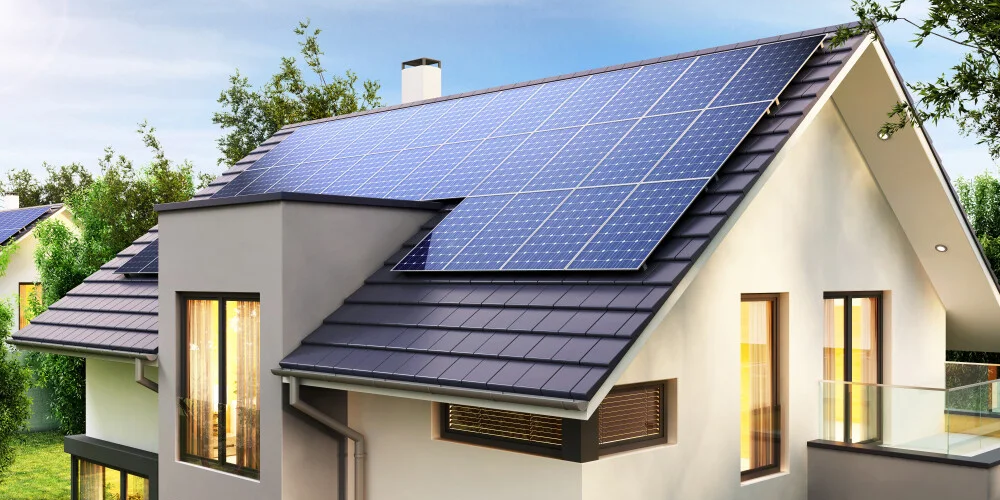
Solar panels and home batteries make the AC/DC story even more interesting. Panels produce DC on your roof. Inverters convert that DC into AC so its energy can be used in your home and on the grid. Batteries store energy in DC form, meaning their charging and discharging also involve conversions to and from AC.
In some setups, electricity may bounce between AC and DC several times before it ends up as being usable—lighting a room, charging a phone, running a pump. Each conversion introduces small inefficiencies that, while not disastrous, are worth understanding when you look at your HEMS performance.
When you see in Homey that your solar production is high but your net export is lower than you expected, part of the explanation lies in these flows and conversions. They are not mistakes; they are simply the way modern electrical systems work.
Why This Matters for Homey and Your HEMS
So why should you care about AC and DC when designing Flows and reading graphs in Homey?
First, it helps you interpret base load. When Homey and your smart meter show a constant draw of a few hundred watts even at night, you can suspect a cluster of DC adapters and electronics quietly running in the background. That points you toward practical actions such as grouping certain devices on smart plugs and letting Homey switch them off at appropriate times.
Second, it clarifies what Homey is actually measuring. When you see a device’s consumption in Homey Energy, you’re seeing the AC side that feeds its power supply, not the internal DC. Similarly, inverter integrations show what’s happening at the conversion between DC panels and your AC system.
Third, it influences how you reason about storage and self-consumption. A home battery doesn’t just magically “keep” energy; it participates in this web of conversions between DC storage and the AC world of your home and the grid. Homey can help you manage this, but understanding the basic picture helps you set realistic expectations.
Ultimately, knowing a bit about AC and DC makes the data from your HEMS less mysterious. You start seeing your home as a dynamic electrical ecosystem, not just as a collection of devices. That mindset makes it easier to spot where Homey can make a difference—and where the physics of electricity simply are what they are.
FAQs
Why does my smart meter measure AC and not DC?
AC (Alternating Current) is the standard format for the electricity grid and household wiring because it is efficient for transport. Since your smart meter sits at the connection point between your home and the grid, it measures the AC power flowing through that connection, regardless of what your internal devices eventually convert it to.
Why do I have a "base load" when everything is turned off?
Many modern electronics (like routers, TVs, and chargers) run on DC internally but plug into AC sockets. They use power adapters or internal supplies to make this conversion. These adapters often draw a small amount of power continuously, even when the device is idle, creating a constant background consumption known as base load.
How does solar energy fit into the AC/DC picture?
Solar panels generate DC power naturally. However, your home and the grid run on AC. An inverter is required to bridge this gap, converting the DC from the roof into usable AC for your home. This is why the inverter is a central component in any solar setup.
Why is there a difference between what I produce and what I use?
Energy is lost whenever electricity is converted from one form to another (AC to DC or vice versa). If you store solar energy in a battery and then discharge it later, it undergoes multiple conversions. These small efficiency losses mean you never get back 100% of the energy you generated or stored.
How can Homey help manage these "invisible" loads?
By monitoring your total consumption, Homey can help you identify clusters of always-on electronics that contribute to your base load. You can then group these devices onto smart plugs and create Flows to cut their power completely at night or when you are away, stopping the adapters from drawing current unnecessarily.
Glossary
AC (Alternating Current)
The standard form of electricity delivered by the grid and found in your wall sockets. The current changes direction many times per second. This is the "language" your smart meter uses to measure total household consumption.
DC (Direct Current)
A type of electricity where the flow is in a single direction at a stable voltage. This is the internal power format for most modern electronics (phones, LEDs, computers), solar panels, and batteries.
Inverter
A device responsible for converting the DC electricity generated by solar panels (or stored in batteries) into the AC electricity needed for your home's appliances and the power grid.
Conversion Loss
The small amount of energy wasted—usually as heat—whenever electricity is transformed from AC to DC or DC to AC. These losses explain why the energy output of a system is often slightly lower than the input.
Power Adapter
The physical component (often a "brick" on a cable or a bulky plug) that converts AC power from the wall into the specific DC voltage required by an electronic device. These are common contributors to a home's base load.


