






Control Any Smart Home Device via Matter with Homey
Not all smart home devices support Matter directly. Many devices use technologies such as Zigbee, Z-Wave, Bluetooth, infrared, 433 MHz, or proprietary Wi-Fi integrations. Some were released long before Matter existed.
To control these devices in Matter-based platforms, you need a smart home hub that can connect to them and present them as Matter-compatible devices.
Homey acts as a Matter Bridge.
Homey connects to devices using their native technologies and exposes supported devices to Matter when they can be mapped to a supported Matter device type. Homey remains in control of the devices. Matter-based platforms access them through Homey.
What “any smart home device” means with Matter
With Homey, this can include devices using:
If Homey supports a device and it can be mapped to a supported Matter device category, it can typically be exposed to Matter in a standardized form.
Not every device type or feature can be bridged. Matter supports specific device types and capability models.
What You Need
To control smart home devices via Matter, you need:
- A Homey Pro or Homey Bridge in combination with a Homey Pro mini or Homey Self-Hosted Server.
- One or more devices added and working in Homey
- A Matter-compatible controller (such as Apple Home or Google Home with Matter support)
All devices must first be added to Homey, before they can be controlled via Matter.
What “Exposing Devices” Means with Matter
When Homey exposes a device to Matter:
- The device remains paired with Homey
- Homey continues to control the device
- The device becomes available to Matter controllers as a standard Matter device
Matter controllers do not communicate directly with Zigbee, Z-Wave, IR, or 433 MHz devices. They communicate with Homey as a Matter Bridge.
In simple terms: Homey translates many different device technologies into standardized Matter device types.
How to Expose Devices to Matter with Homey
You do not need to re-pair devices or change how they are connected.
The process works like this:
1. Add devices to Homey
Make sure the devices you want to use are already added to Homey and working correctly.
2. Open Matter Bridge settings
Install and open the Matter Bridge app in Homey.
- In the Homey mobile app:
More (⋯) → Settings → Matter Bridge - In the Homey Web App:
Settings (⚙︎) → Matter Bridge → Configure
3. Add Homey as a Matter Bridge
In your Matter controller (for example Apple Home or Google Home):
- Add a new Matter device (bridge)
- Scan the QR code shown in Homey
This commissions Homey as a Matter Bridge.
4. Select devices to expose
During setup, choose which Homey devices you want to expose via Matter. Only selected devices will be shared.
After setup, the selected devices appear in your Matter platform. They remain paired with Homey.
No additional pairing steps are required.
How the Connection Works
Behind the scenes, the architecture looks like this:
- Devices connect to Homey
Homey communicates with devices using their native protocols. - Matter controllers connect to Homey
Matter platforms communicate with Homey as a Matter Bridge. - Homey forwards commands
When you control a device via Matter, Homey translates the command and sends it to the device.
Homey remains the central logic and control layer.
What You Can Do via Matter
Once exposed, devices appear as standard Matter device types (depending on their capabilities), such as:
- Lights (on/off, dimming, color, temperature)
- Plugs and switches
- Thermostats
- Locks
- Blinds and covers
- Sensors (motion, contact, temperature, humidity, air quality, smoke, CO₂ — where supported)
You can:
- Control devices in Matter-compatible apps
- Use voice assistants connected through Matter
- Include devices in Matter-based automations
What to Keep in Mind
- Matter exposes standardized device capabilities, not every device-specific feature
- Some action-based devices (for example IR or 433 MHz devices) may not report real-time state
- Advanced automation logic stays in Homey
- Removing a device from Homey also removes it from Matter
Use Matter for cross-platform control and interoperability and Homey for automation, advanced logic, and coordination across technologies.
In Short
Matter does not need to support every device technology directly.
Homey connects your smart home devices and exposes compatible ones to Matter in a standardized way, regardless of the underlying technology.
Matter becomes a universal way to access your smart home across platforms Homey stays in control.
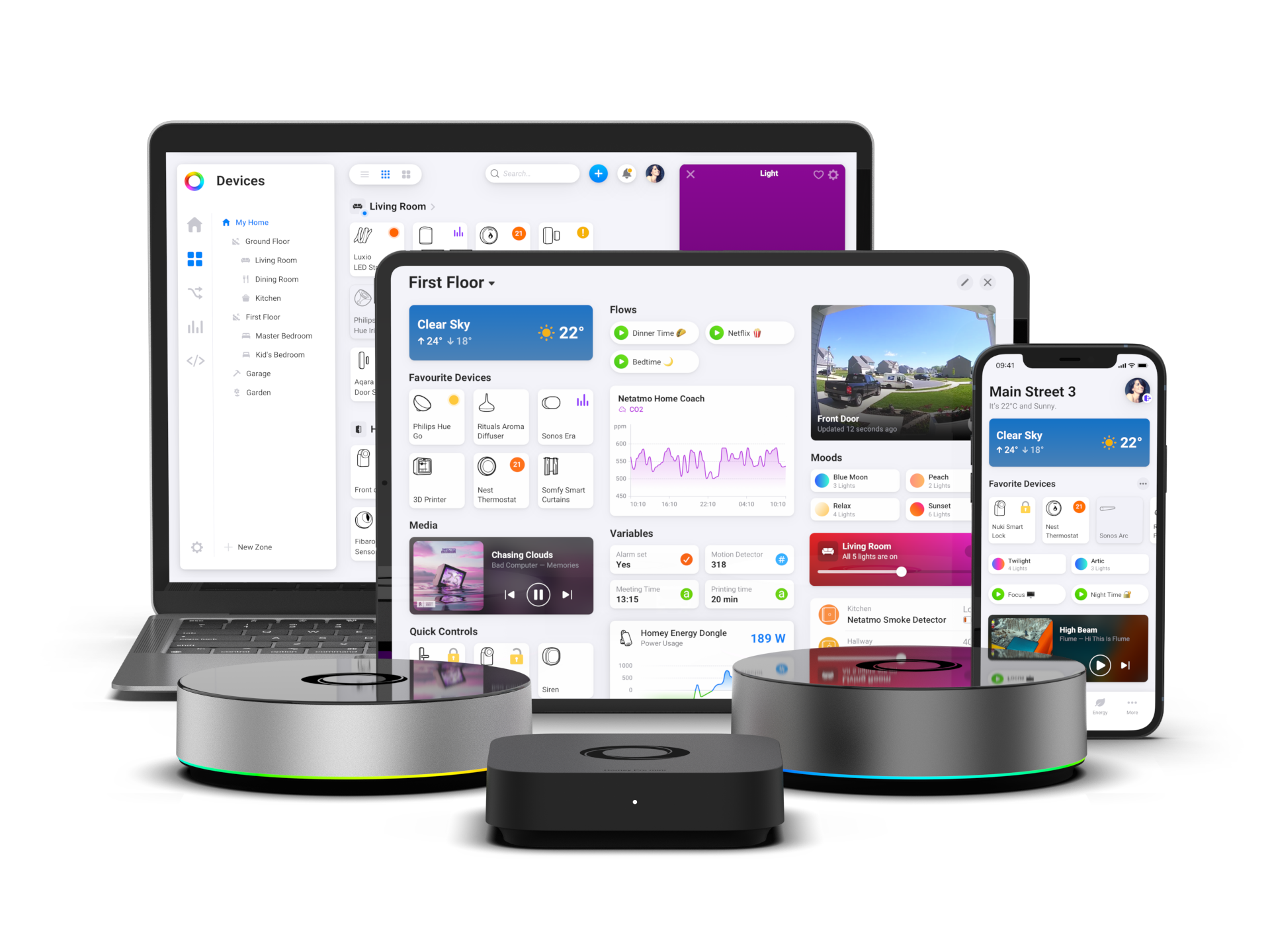
Discover more about Homey by connecting additional devices through the Homey App Store. Control them with the Homey App and create your own automations with Flows and Advanced Flows. Monitor your smart home using Dashboards, and gain deeper understanding with Homey Energy and Insights.
Smart home technologies and platforms supported by Homey
Smart homes often use multiple wireless technologies and platforms. As a powerful smart home hub, Homey supports a wide range of communication standards, including Zigbee, Z-Wave, Matter, Thread, KNX, 433 MHz, Wi-Fi, Bluetooth and Infrared.
Homey also integrates with popular smart home platforms such as Amazon Alexa, Google Home and Apple Home. By combining multiple technologies and platforms in one system, Homey allows devices from different ecosystems to work together in one flexible smart home setup.


