






What is Bluetooth?
Bluetooth is a short-range wireless technology that lets devices talk to each other without needing your WiFi router. It’s the quiet helper behind plenty of everyday moments: your headphones pairing in seconds, your car connecting to your phone, and—more and more—smart home devices that can be set up quickly and controlled nearby.
In a smart home, Bluetooth isn’t usually the “whole-house backbone.” Instead, it’s the friendly handshake at the door: great for pairing, great for close-by control, and surprisingly useful for presence-based tricks—like knowing when you’re home without you lifting a finger.
Bluetooth in short
Bluetooth is designed for nearby connections and low power use. That’s why it’s common in devices that need to run on a battery for a long time or that are meant to be used close to where you are.
In smart home terms, Bluetooth is often used for things like smart locks, beacons, sensors, and some lighting products—especially during setup. It’s also a popular way for a device to connect directly to your phone without relying on the internet.
Because Bluetooth is typically short-range, it’s best when the device and the controller (often your phone, or a hub that supports Bluetooth) are relatively close together.
Bluetooth Low Energy (BLE): the battery-friendly version
Homey Pro has BLE built-in, while Homey Pro mini and Homey Self-Hosted Server , require Homey Bridge for BLE support. Bluetooth Low Energy is a wireless communication standard with reduced power consumption compared to classic Bluetooth. Bluetooth Low Energy uses the 2.4GHz radio frequency.
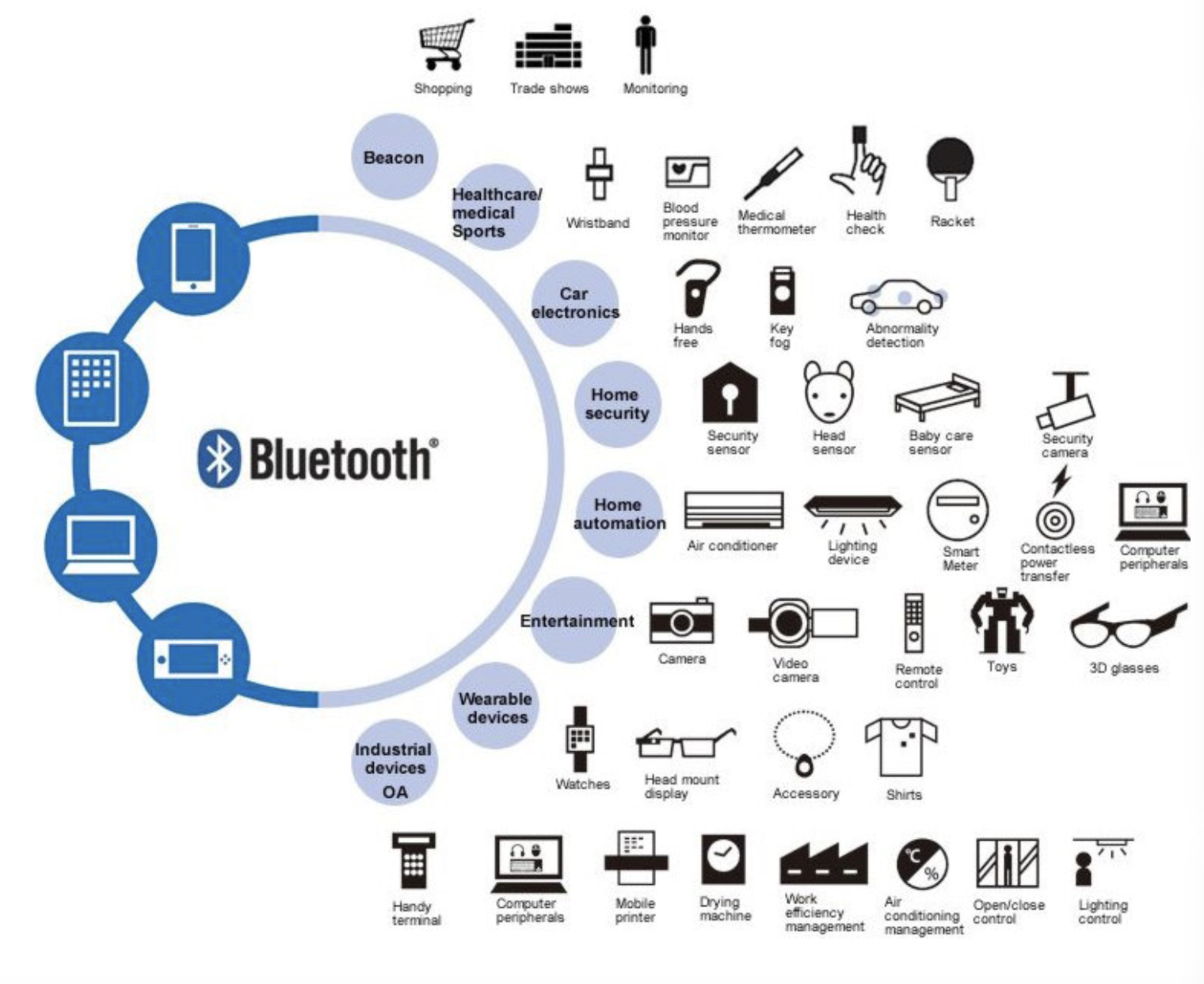
If “classic” Bluetooth is the one you think of for audio—headphones, speakers, car kits—then Bluetooth Low Energy (BLE) is the version made for sensors and small, always-on signals.
BLE is designed to sip power instead of gulp it. That’s why it’s so common in smart home sensors, beacons, and trackers: they can broadcast tiny updates (like “door opened” or “someone is nearby”) without draining a battery in weeks. In practice, BLE devices often “check in” in short bursts, then go right back to sleep. That makes BLE a great fit for presence detection, simple status updates, and quick setup experiences—especially when you want something to work smoothly without adding another hub or wiring.
It’s also why you’ll sometimes see a product described as “Bluetooth” when it actually means “BLE”—because in smart home land, BLE is often the default Bluetooth flavor.
How Bluetooth works in a smart home
Bluetooth creates a direct wireless link between devices. Most of the time, your phone is the “controller” that finds the device, pairs with it, and sends commands. That can make Bluetooth feel refreshingly simple: no WiFi passwords, no router troubleshooting, no “why won’t it join the network?”
This is also why many smart home products use Bluetooth during onboarding, even if they later work over another network. Pairing over Bluetooth can be faster and more reliable than trying to discover a brand-new device over WiFi in a busy home network.
Bluetooth can also help with “presence moments.” A small Bluetooth beacon (or your phone itself) can act like a signal that says, “I’m here,” which can be used to trigger home automations—like turning on lights as you arrive or pausing motion-based alarms when you’re home.
Bluetooth vs WiFi, Zigbee, Z-Wave, Thread, and Matter
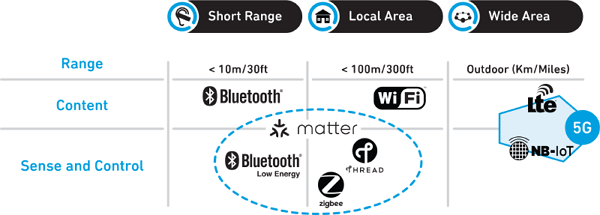
Bluetooth’s biggest strength short-range, direct connection, is also its biggest limitation.
WiFi is built for home-wide networking and high-bandwidth devices, like cameras and speakers. Zigbee and Z-Wave are designed for smart homes with reliable, low-power communication and mesh networking, which means devices can pass messages along to extend coverage. Thread is also a low-power mesh network, and it’s often used as a transport for Matter.
Matter itself is the shared “language” that helps devices work together across ecosystems. Most Matter devices use WiFi or Thread as their transport, not classic Bluetooth. But Bluetooth still plays a role in the Matter world: it’s often used during setup to help a phone securely hand off credentials to the device.
Range and reliability: what to expect
Bluetooth is usually strongest in the same room and nearby rooms, but walls, floors, and distance can reduce reliability quickly. That’s why Bluetooth devices can feel rock-solid for close-by interactions—like unlocking the front door when you approach. However, it's less suitable for automations that need to reach a shed, attic, or far corner of the home.
For whole-home smart home reliability, Bluetooth is often paired with other technologies. WiFi covers the bigger devices and internet connectivity, while Zigbee, Z-Wave, or Thread handle sensors and switches across the house. Bluetooth then becomes the “nearby superpower” in the mix: fast pairing, simple setup, and presence-style interactions.
How Bluetooth fits into Homey
Homey is built to bring different smart home technologies together, so Bluetooth can play a practical supporting role—especially when a device uses Bluetooth for setup, local control, or close-range features like presence.
In a Homey setup, Bluetooth is usually not the only connection type you’ll rely on. Instead, it’s one of the tools that can make a smart home feel smoother: fewer apps, fewer pairing headaches, and automations that don’t depend on you remembering to tap a button.
Conclusion
Bluetooth is the smart home’s “close-by connector.” It’s perfect for quick pairing, simple local control, and presence-style moments that make your home feel responsive—without adding complexity. It may not be the best choice for whole-home coverage on its own, but in combination with WiFi and smart home networks like Zigbee, Z-Wave, Thread, and Matter, it helps everything feel more effortless.
Ready to make your smart home feel a little more seamless? Pick one Bluetooth-powered use case—like easier setup or arrival-based automations—and let Homey connect it to the rest of your home, one smart moment at a time.
Did you know?
Bluetooth has a distinctly Dutch origin story, like Homey. Dutch engineer Jaap Haartsen developed the technology in 1994 at Ericsson and even though the patent carried his name, Ericsson owned it, so he didn’t become rich from it. Still, the impact of his invention is enormous, earning him a place in the U.S. National Inventors Hall of Fame, alongside names like Steve Jobs and Alexander Graham Bell.
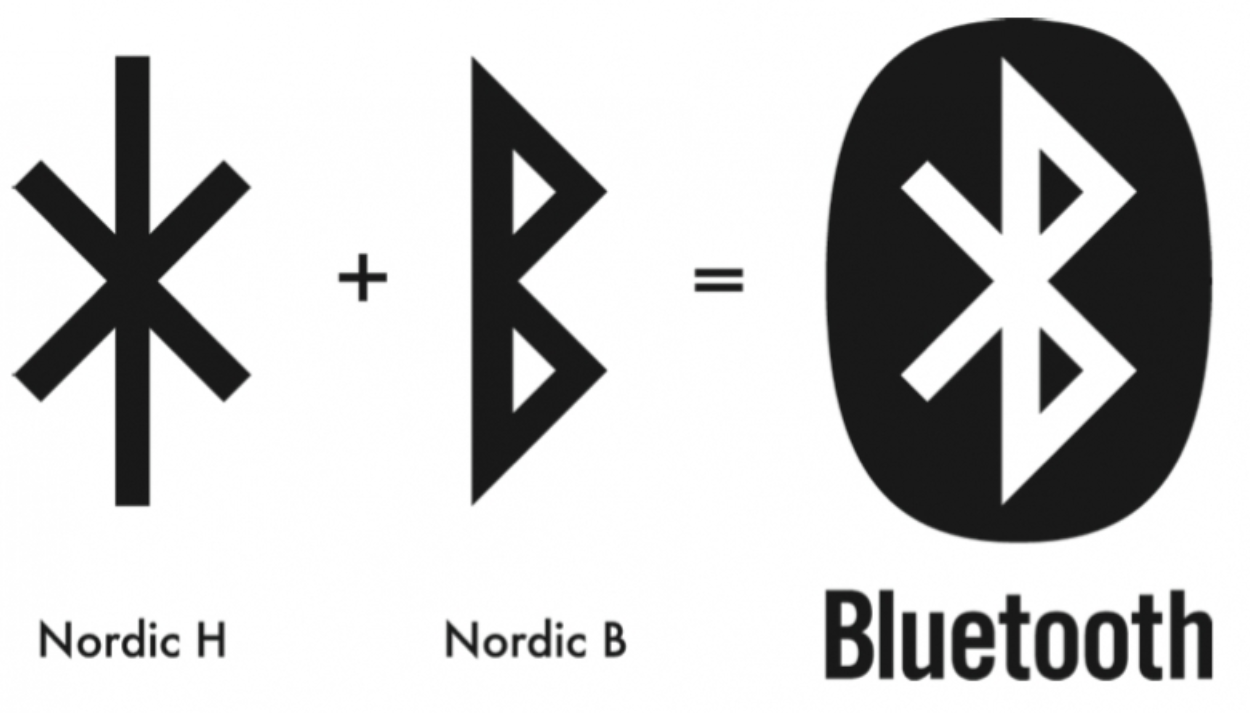
The name Bluetooth started as a codename, inspired by the Danish Viking king Harald “Bluetooth” (Blåtand), who was known for connecting people and regions in the 10th century. Even the logo is a nod to him: it combines his initials written in runic script.
Smart home technologies and platforms supported by Homey
Smart homes often use multiple wireless technologies and platforms. As a powerful smart home hub, Homey supports a wide range of communication standards, including Zigbee, Z-Wave, Matter, Thread, KNX, 433 MHz, WiFi, Bluetooth and Infrared.
Homey also integrates with popular smart home platforms such as Amazon Alexa, Google Home and Apple Home. By combining multiple technologies and platforms in one system, Homey allows devices from different ecosystems to work together in one flexible smart home setup.


