






 Written by Dino K.
In this edition of the Smart Home Founder Series, we sit down with George Yianni from Signify to explore how Philips Hue grew from an internal startup into a global standard, what drives its obsession with reliability, and how he sees the smart home evolving through AI and smart sensing.
Philips Hue is the definitive premium lighting brand, blending high-performance hardware with seamless experiences. Built on a robust Zigbee mesh network, Hue focuses on transforming the home through ambiance, entertainment, and security, all while leading the industry toward greater interoperability with standards like Matter.
Hello George, thanks for joining me today. Before we talk about Philips Hue, I want to start with Signify itself. For readers who are not familiar with the company, can you briefly explain how Signify began and how it grew into the lighting company it is today?
GEORGE: “So, Signify goes back quite a long way. We are the spin-off of Philips’ lighting division. Philips itself started as a lighting company back in 1892. It was the first European company to industrialize artificial light, so there is a very long heritage there.”
“Over the last 120 years, Philips grew and diversified into many different activities, and in more recent years, it also spun off a lot of those divisions. Large companies like NXP, ASML, TomTom, and TP Vision all started as spin-offs or joint ventures of Philips. The lighting division followed the same path. It spun off in 2016 via an IPO. At first, it was called Philips Lighting. When Philips no longer had a majority shareholding, we rebranded to Signify, while keeping the Philips brand under an exclusive brand license for lighting products.”
“Philips Hue originally launched as part of Philips, but was included in that spin-off and became part of Signify. Today, Signify is the world’s largest manufacturer and provider of artificial lighting. We are active in every segment, from lighting football stadiums, monuments, and landmarks like the Eiffel Tower and the Empire State Building, to office and retail lighting, to the regular bulbs you buy for your home, and of course, the new class of smart bulbs like Philips Hue.”
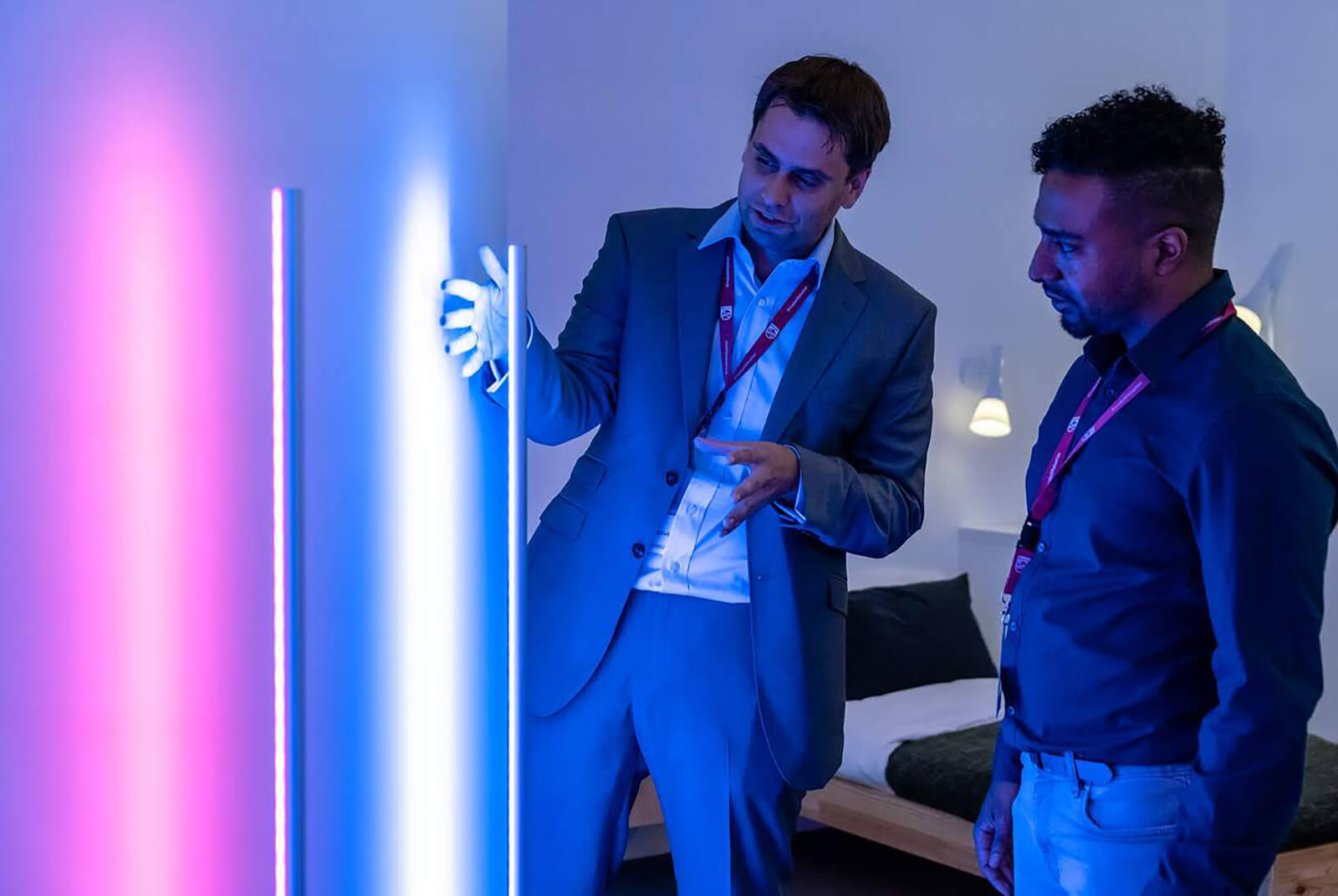
Signify owns several smart lighting brands, including Philips Hue and WiZ. For people who get confused by all the names, can you explain the differences between these brands and what role each one plays in your portfolio?
GEORGE: “We offer two different consumer smart lighting systems at Signify. One is Philips Hue, and the other is WiZ, and they differ in both market positioning and the core technology stack they use.”
“Philips Hue is based on Zigbee, which is a low-power wireless mesh network technology inside the home. It gives you very fast, reliable full home coverage. There is a bridge in the home that serves as a central edge-computing resource. It allows automations, switch behavior, and real-time functionality to run locally, without relying on the cloud. Hue is really positioned as a full-system offering. If you want multi-room smart lighting that works seamlessly with sensors, switches, and smart home integrations, Philips Hue is the best solution you can buy.”
“WiZ is more focused on smaller-scale, app-enabled lighting. It uses Wi-Fi and is aimed at people who buy one or a few products and control them directly via a mobile app, with fun, playful features. So Hue is the more premium full home system, while WiZ is a simpler, more accessible smart product-based offer.”
Philips Hue is one of the most recognizable smart lighting brands in the world today. Can you share how Hue itself originally came to life inside Philips and how it grew into what it is now?
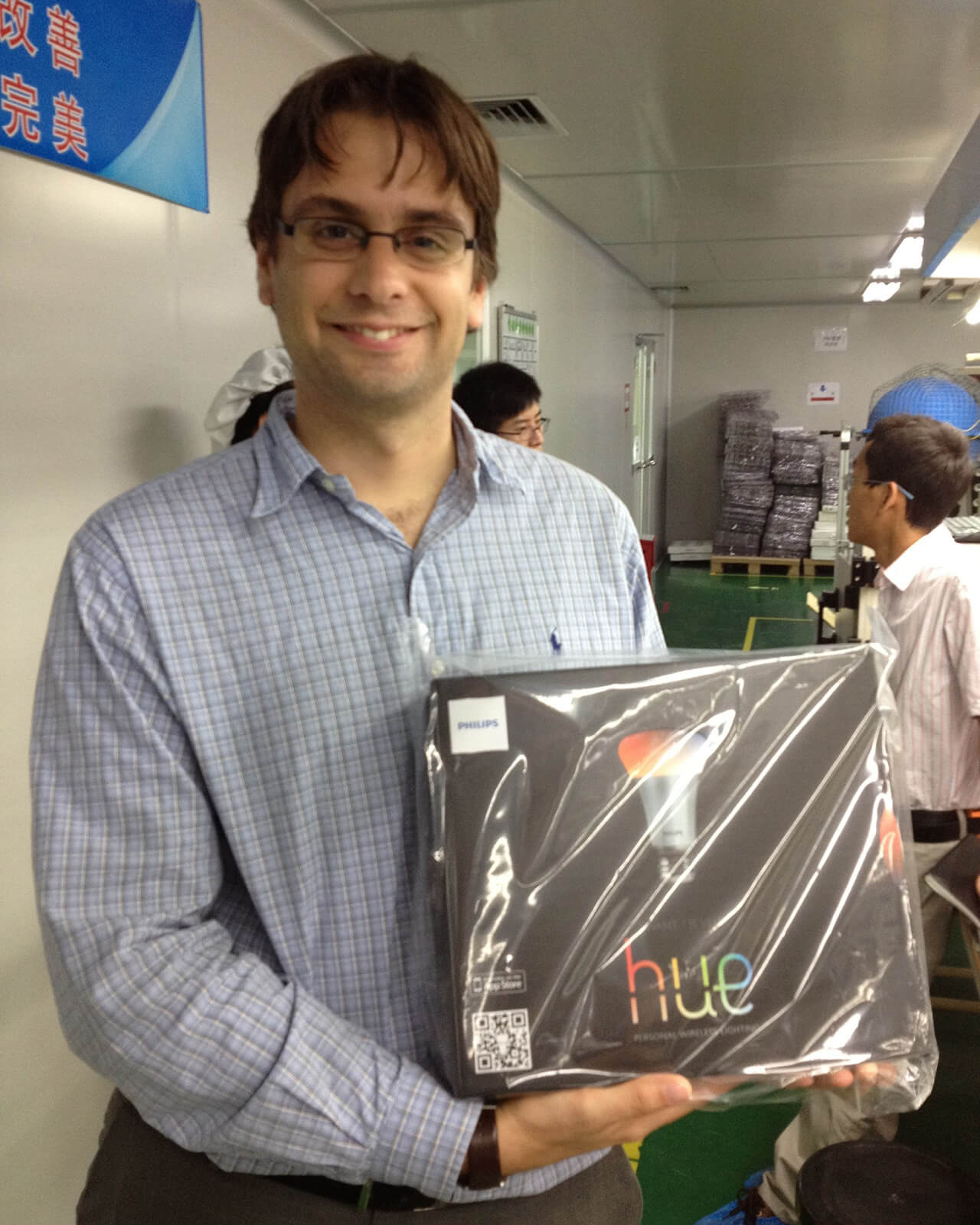
GEORGE: “Hue actually started as an internal startup within Philips. At the time, Philips had an internal startup incubator, and I started a small venture there focused on building software and services for consumer luminaires. That is where we developed the first apps and the first bridges for consumer lighting, in a very classic startup style with a stage-gated process.”
“We then launched the first Hue products, and that launch was a big success. We even had an exclusive launch with Apple, and we managed to persuade Apple to sell light bulbs, which was quite something back then. From there, we grew up inside the company.”
“So even though Hue has always been part of a big corporation, it still has a bit of a startup culture. That is really where it came from, as an internally incubated startup that grew into one of the larger businesses within Signify. I think that is a nice part of the Hue genesis.”
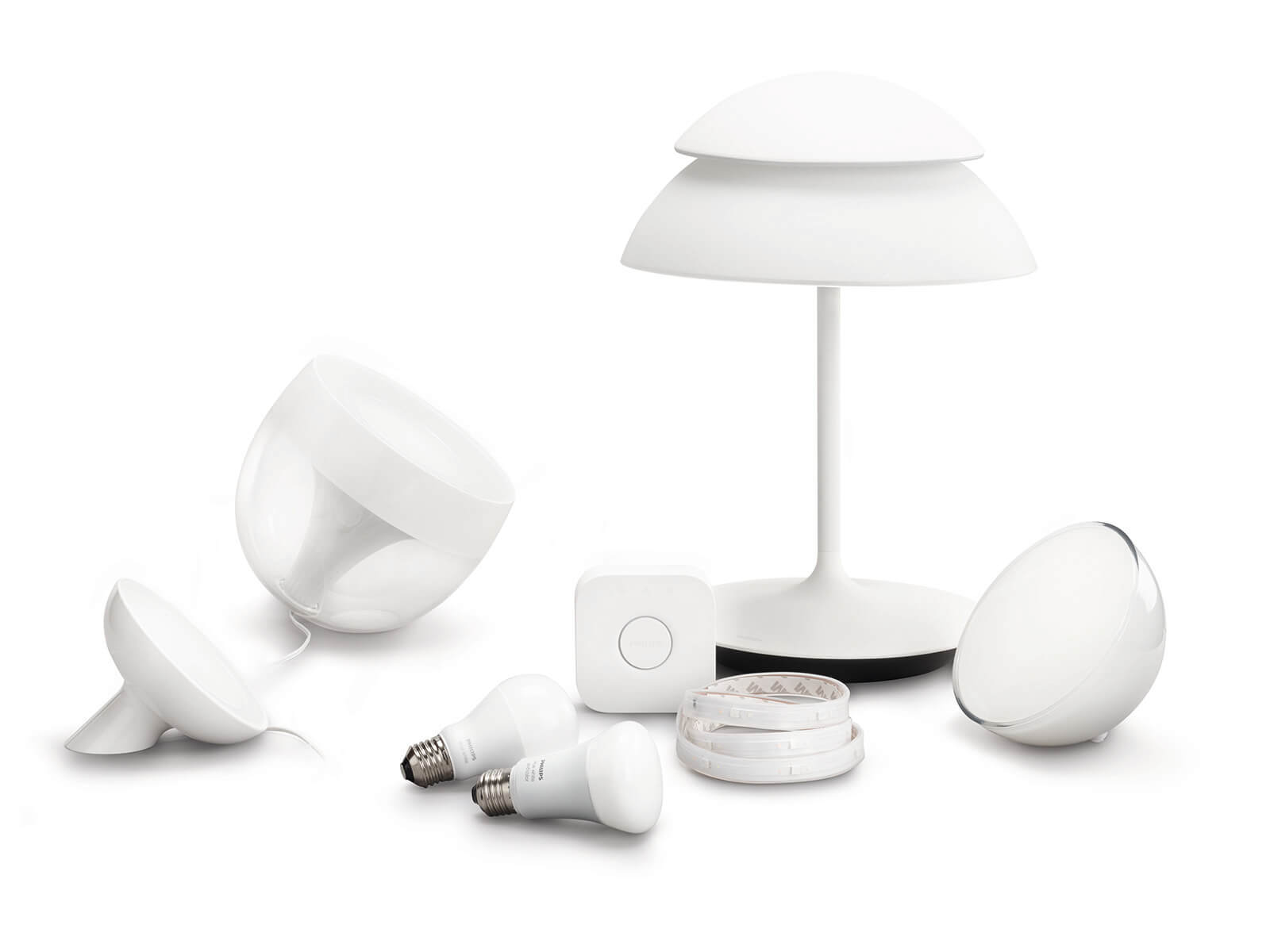
Philips Hue has grown far beyond bulbs, now offering switches, sensors, outdoor lighting, gradient products, and more. Are there any new categories or device types you are considering adding in the future?
GEORGE: “From the beginning, the mission of Philips Hue has been to change the role of light in the home, to unlock its potential beyond simple illumination. To do that easily, you cannot only offer light bulbs. You need complementary products in your portfolio.”
“Many people are happy controlling lights with a smartphone, but it is also very convenient to hit a button when you walk into a room or to have a sensor see you and turn the lights on automatically. That is why, very early on, we started looking at which additional products we needed in the ecosystem. We launched our first smart switches in 2014 with the Hue Tap, motion sensors in 2015, and in 2019, we launched entertainment sync devices that analyze HDMI video to enhance media consumption with light. More recently, to unlock the potential of lighting in securing our homes, we added contact sensors and security cameras.
“The guiding principle is always the same. Lighting is the only product that is truly in every room of the home, making it the perfect vehicle for sensing what is happening in your home. That is at the core of a security system. But once you detect that something is happening, you also need to know what it is, and that is where cameras come in. Whenever we move into adjacent product categories, there needs to be a strong reason related to unlocking more potential from light.”
“So, if we take the example you gave, like an air quality or air purity sensor, we would only do that if there were a strong shared use case with smart lighting. Otherwise, other companies can do it very well. What makes us stand apart is that we focus on a limited set of things and try to do them really well, rather than going extremely broad.”
Philips Hue is known for being one of the most reliable smart lighting systems. What would you say is the main reason Hue performs so consistently compared to other brands?
GEORGE: “I think the first thing you need to do is plan and design for reliability. We made many deliberate design choices over a long period to make sure everything works reliably and quickly.”
“For lighting, the expectations are sky high. We all take for granted that when we walk into a room and hit a light switch, the light turns on instantly every single time. I firmly believe that if you buy a smart version of a product, it should do more than what you had before, not less. That mindset was baked into how we architected and designed Hue from the beginning. We wanted to replicate that experience where you walk into a room, press a button, and all the lights turn on within about half a second, which is perceived as instant, and then build extra functionality on top of that.”
“At the lowest level of the architecture, we said that everything that can be done in the home should be done there. We do not want the cloud involved in any real-time interaction. That is why we have the bridge. We also did not want people to have to think about networking when installing a light bulb, so we chose a technology that automatically builds a reliable network in the background. That is what the Zigbee mesh gives us.”
“Another critical factor is that we build both sides of the system. Because we have the bridge and own all the devices, we can test and optimize their interaction perfectly. We can orchestrate the entire network, fix issues, and tune performance end-to-end.
“And finally, we commit to our products long-term. We continue to support, upgrade, and improve the products we launched ten years ago. They still get software updates. We do not move on and forget about them. We see the home installation as a system, and we keep iterating to make it more reliable and more performant over time. After thirteen years of doing that, consumers really benefit from it.”
Philips Hue has used Zigbee from the very beginning. What makes Zigbee such a good fit for smart lighting, and why has it remained your leading technology for so long?
GEORGE: “In the early days, we looked at a lot of different technology options for Hue, and we chose Zigbee. Thirteen years later, I still feel confident that it remains the right choice, even with all the new developments since then. Zigbee itself has evolved. We started with a particular variant and then worked with the alliance to improve it, upgrade it, and integrate different variants. But the core choice is still valid.
“For smart homes with many devices, you need a low-power dedicated IoT network. You shouldn’t be using Wi-Fi for that. Zigbee is simply the most performant, efficient, and reliable option available for that use case. Thread has a lot of similarities, but it is less efficient for us because of the additional IP layer on top, which does not add value for our specific use case. Zigbee is more optimized, and that lets us build features with higher performance. And again, because we control both sides, we can really optimize the whole stack to work well together.”
Hue’s Zigbee ecosystem also enabled technologies like Friends of Hue switches and accessories. Are there any Zigbee features or capabilities you feel are still underused or not widely understood by consumers?
GEORGE: “I’ve been involved in the technology exploration and development from the very beginning, and it’s nice to see how far it has come. For me, the biggest underutilized feature in our system is the fact that all our products can work fully standalone with a remote control.”
“You do not actually need a bridge to use Hue. The bridge is optional if you want the advanced functionality. Every product we have ever sold can be touch-linked one-to-one with any of our remote controls via proximity, so you can control it directly. For many use cases, that’s perfectly fine, and for many consumers, it’s all they need.“
“On top of that, for three generations now, all our bulbs also have Bluetooth, so people can control them directly with just a smartphone app. That is ideal for room-based setups.”
“From a Zigbee perspective, the interesting part is one-to-one touch linking. A key innovation in the Zigbee variant we started with — now part of the mainline standard — is the concept of a distributed trust center. It allows a device and a light to securely pair and establish a secure connection without a central controller. That is what makes direct control possible. I think that is still underused and not as well known as it could be.”
Hue bulbs acting as presence sensors is a new idea for many users. In simple terms, how does a light bulb detect when someone is in the room, and how does this technology work?
GEORGE: “This is an innovation we have been working on for about seven years. It took a long time to get it reliable enough to put into people’s homes. As you said, the quality bar for Philips Hue is high. When we ship a feature like this, it needs to work.”
“The way it works is that we take a group of lights in a room, typically three or four. Those lights start sending small amounts of data to each other. They do this outside of Zigbee, on the bare radio layer, using inter-PAN packets on the 802.15.4 layer. So light one talks to light two, two talks to three, three talks back to one, and so on.”
“From that traffic, we capture the signal interference of the messages. One of the bulbs in the room collects all the signal-interference data and sends it back to the Hue Bridge Pro. There, we run complex algorithms that have been trained to recognize how changes in those interference patterns over time correspond to a human moving through the space. When the pattern matches a human presence, we generate a presence event.”

“We did enormous amounts of data collection, processing, and tuning to make sure the algorithm ignores all the wrong things. The radio spectrum in a home is noisy. We do not want lights turning on because water is flowing through a pipe or because it is raining on the roof. The feature essentially looks for water moving between the lights, because in our bodies, water interferes with radio waves.”
“You can tune the sensitivity so that it will ignore a small bag of water that might be a cat, while still detecting a human-sized object. You cannot distinguish a large dog from a human, but you can filter out smaller animals. Because the radio signals also reflect off walls, it does a good job of covering the area around the chosen lights through multiple paths.”
“What I am especially proud of is that we could bring this to our installed base. Around 95 percent of all Hue products ever sold received this as a free software update, including ten-year-old bulbs. That is quite unique.”
With Thread and Matter now taking over the industry narrative, how do you see Zigbee’s role evolving within Hue in the long term? Are we going to see Thread-only releases in the future?
GEORGE: “I believe Zigbee is here to stay and that it remains the right choice for bridge-to-light communication, because in that setup, you control both sides and can be highly efficient.”
“Thread shares many of Zigbee’s benefits, but because it uses the radio spectrum less efficiently, certain features would not perform as well. For example, our motion-aware RF sensing feature could probably be done over Thread, but it would not be as fast or as scalable because of the extra data on the network. The same goes for our entertainment streaming feature. On Thread, we would not be able to stream to as many lights at the same quality.”
“Our view is that there is no single radio technology that is best for every use case. If you want simple room-based control, Bluetooth is often the best choice. If you want a highly optimized bridge-and-lights ecosystem controlled by a single player, Zigbee is the most efficient and best-performing. And if you need interoperability across many different device types and verticals, with an IP layer and Matter to ensure that, then Matter over Thread is the right tool.”
“What we do not want is for consumers to have to compromise. That is why we worked with our silicon partners to build next-generation chips, used in many of the products we recently launched, that can run Zigbee, Matter over Thread, and Bluetooth in parallel. That way, we can use the right technology for the right use case, and all three play a role.”
With Matter now supported on the Hue Bridge and the Hue Bridge Pro, it is easier for users to connect Hue across different platforms like Homey. What limitations still exist with Matter today, and what improvements do you think will matter most as the standard evolves?
GEORGE: “All our products have supported Matter via the bridge for quite some time. We were launch members and the first gateway to support Matter. One of the unique things about Hue is that if you wanted your Hue products to work with Matter, you did not need to buy new devices. We pushed a software update to the installed base, and suddenly, a million lights worked with Matter from day one.”
“That fits our philosophy of continuing to invest in the products we have already sold, making them interoperable with new standards that did not even exist when we first designed them. More recently, we are also starting to offer direct Matter support in the bulbs themselves for people who want to pair them directly to another smart home system. They can even do that while still having them linked to a Hue Bridge, if they want to minimise hops and devices in their setup.”
“In terms of limitations, Matter is structured in a way that allows you to build your own features on top of or next to the standard. That is important because if everyone had to wait for every idea to become part of the standard, innovation would slow down too much. So we are happy we can innovate alongside it.”
“The downsides are more linked to Thread. The higher network load limits the performance of some use cases. But I think the real thing holding Matter back today is not on the device side but on the controller side. Even if a feature is part of the standard, there is no guarantee that the controllers will support it.”
“A simple example is scenes. With Hue, we really care that when you press a button, all the lights fade on together smoothly. We contributed that functionality to the Matter standard so we could reproduce the same experience there. But many ecosystem owners, the Matter controllers, still do not implement it, so you get that effect where lights pop on one by one. There are many requirements for devices and far fewer for controllers, which keeps things a bit fragmented. It means you cannot always trust that the right features will be supported consistently for consumers across ecosystems.”
Smart lighting has changed a lot in the last decade. What do you think will be the biggest change in the next ten years, either in the technology itself or in how people use lighting at home?
GEORGE: “I see two big changes coming over the next five to ten years. The first is around the user interface, how we interact with our homes. Up until now, you have basically had two choices. Either you use the dedicated app for a particular product and get a very optimized deep experience for that category, like our Hue app for lighting, or you use a smart home platform that reduces everything to an on and off switch and a slider so that it can scale across many devices, but without going very deep.”
“If you try to do everything in one user interface, it quickly becomes very technical. That has been a fundamental limitation in what you can do from a user experience point of view. I think that will change as complex use cases move to natural language interfaces with AI. Instead of manually building complicated automation flows with lots of if-this-then-that rules, you will be able to describe what you want in plain language and have it happen automatically.”
“That will enable more optimized, fun-to-use interfaces that can still cover everything, because all the complexity is handled by natural language agents in the background. It will be transformative in making rich, multi-vertical smart-home use cases accessible to everyday people.”
“The second big change is linked to automation. With the ability to do more complex orchestration, there will be a huge push to make products behave more automatically based on sensing. That means bringing more contextual information into the home about what is actually happening, and using that to respond automatically to what you need. There will be a strong drive to add sensing capabilities, and lighting is a perfect platform for that because it is already in every room. In some cases, we can even do it by analyzing radio waves, without adding new hardware, like with MotionAware.”
“So overall, I think you will see less direct interaction with your smart home, because it will simply do the right thing more often, based on better sensing and smarter automation configured by AI.”
On a more personal note, do you have a favorite Philips Hue product or experience that you consider a hero of the system?
GEORGE: ”Of course, I love all my children equally, but if I pick a favorite experience, it would be my bathroom lighting. Every day I walk into that bathroom multiple times, and I do not have to do anything, yet the light is always at the right setting for the time of day.”
“If I walk in during the night, the light turns on automatically to a dim red setting. First thing in the morning, I get a bright, cool light that is close to daylight, so I see what I will look like during the day. In the evening, the blue content is gone, so it does not disturb my sleep. That happens multiple times a day, and I never have to think about it.”
“Initially, that experience was enabled with a motion sensor and our time-based light feature. Now it is enabled with motion-aware presence sensing and the same time-based scenes, without even needing a separate sensor. For me, that combination of motion and time-based lighting that just quietly gives you the right light whenever you walk in is the best expression of what Hue can do.”
For a new company entering the smart home or smart lighting market today, what is the one piece of advice you believe would make the biggest difference to their long-term success?
GEORGE: “I think the key thing you should always keep front of mind when you innovate for a product in the home is to understand which existing interaction you are going to make better. Do not try to get people to do more things in their homes. Make something they are already doing more valuable.”
“If you do that, it becomes much easier for people to understand and engage with your product. If you are just adding another thing that needs to be controlled, you are increasing complexity without necessarily adding value. Focusing on improving existing interactions is a much better recipe for long-term success.”
Thanks for taking the time to talk with me today, George!
GEORGE: “Thank you for having me. It was a really nice conversation, I really enjoyed it.”


